
Before starting with UGC NET Law Syllabus and Preparation Strategy, Imagine standing in front of a classroom filled with eager law students, or conducting groundbreaking legal research that shapes India’s jurisprudence. This isn’t just a dream—it’s the reality that awaits successful UGC NET Law qualifiers. Whether you aspire to become an Assistant Professor at a prestigious law university or secure a Junior Research Fellowship (JRF) to pursue your doctoral research, the journey begins here.
The UGC NET Law syllabus for December 2025 is your roadmap to academic excellence. With the exam scheduled from December 31, 2025, to January 7, 2026, you have a defined timeline to transform your legal knowledge into a qualifying score. Recent statistics reveal encouraging trends: the June 2025 cut-off for JRF stood at 200 marks for General category, with Assistant Professor qualification at 178 marks, making success achievable with strategic preparation.
Unlike traditional legal practice exams, UGC NET Law exam pattern 2025 tests not just your subject knowledge but your teaching aptitude, research methodology, and analytical reasoning. The exam comprises 150 questions across two papers (Paper 1: 50 questions, Paper 2: 100 questions) totaling 300 marks, with a combined 3-hour duration and no negative marking—a significant advantage for strategic test-takers.
This comprehensive guide will navigate you through every aspect of UGC NET Law preparation strategy, from unit-wise syllabus breakdown to subject-specific study approaches, mock test strategies, and expert insights from successful JRF qualifiers. Whether you’re an LLM graduate aiming for your first attempt or a working professional balancing preparation with practice, this roadmap ensures you’re fully equipped to crack UGC NET Law 2025 and launch your illustrious academic career.
Also Read
1 AIBE 20 (2025) Official Question Paper With Complete AIBE answer key 2025 – All 100 Questions With Detailed Solutions
2 UP APO Previous Year Paper 2022 – Complete Question-wise Solutions
3 AIBE 20 Strategy
Table of Contents
What is UGC NET Law? Understanding UGC NET Law Syllabus and Preparation Strategy {#what-is-ugc-net-law}
The University Grants Commission National Eligibility Test (UGC NET) for Law is a national-level examination conducted by the National Testing Agency (NTA) to determine eligibility for Assistant Professor positions and Junior Research Fellowship (JRF) in law departments across Indian universities and colleges.
Why is UGC NET Law Critical for Your Academic Career?
Think of UGC NET Law as your professional certification for academic excellence—without qualifying this exam, the doors to teaching at UGC-approved institutions remain closed. Here’s what UGC NET Law qualification unlocks:
Assistant Professor Eligibility: Direct eligibility to apply for Assistant Professor positions at universities and colleges nationwide
Junior Research Fellowship (JRF): Monthly fellowship of ₹31,000 (first two years) and ₹35,000 (remaining period) for doctoral research
PhD Admission: Direct admission to PhD programs without additional entrance exams at many universities
Academic Credibility: National-level recognition as a subject expert and researcher
Career Security: Permanent government teaching positions with excellent benefits and growth prospects
UGC NET Law December 2025: Key Updates
Exam Dates: December 31, 2025 – January 7, 2026 (subject-wise schedule to be announced)
Notification Released: October 7, 2025
Application Deadline: November 7, 2025 (closed)
Exam Mode: Computer-Based Test (CBT) across multiple shifts
Results Expected: February 2026
Major Advantage: With no negative marking and strategic preparation, even borderline candidates can secure qualifying marks through educated guessing on uncertain questions.
Complete UGC NET Law Syllabus 2025 {#complete-syllabus}
The UGC NET Law syllabus 2025 encompasses Paper 1 (General Paper) and Paper 2 (Law-specific subjects) divided into 10 comprehensive units covering foundational to advanced legal concepts.
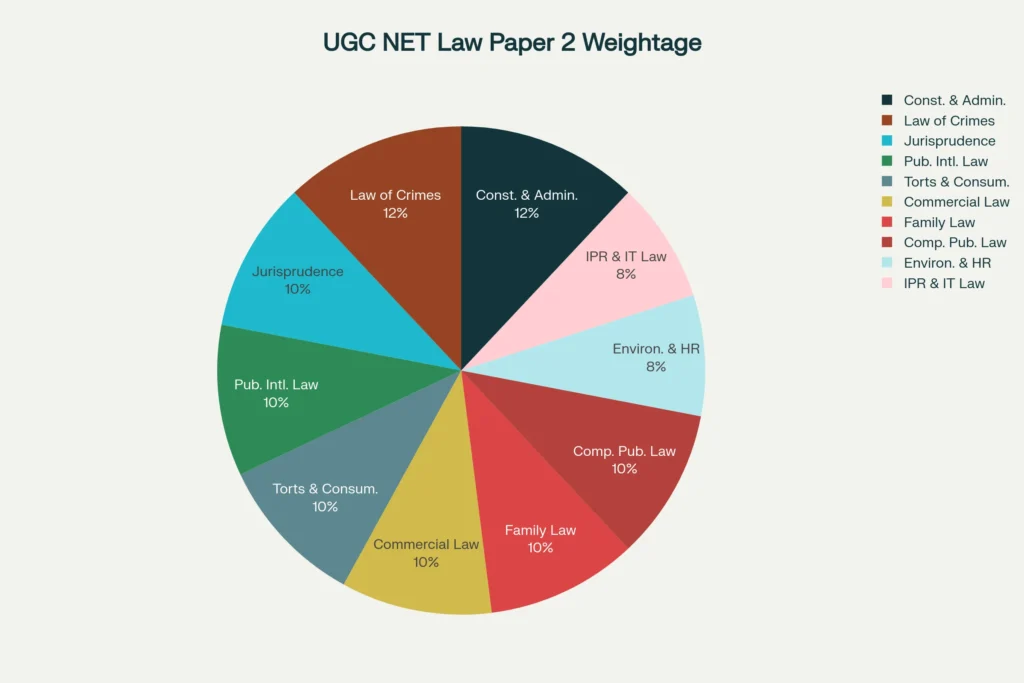
UGC NET Law Paper 2 syllabus weightage distribution showing question allocation across all 10 units for the 2025 examination
Paper 1: General Paper (50 Questions – 100 Marks)
Purpose: Tests teaching aptitude, research methodology, and general awareness—common across all UGC NET subjects.
Key Topics in Paper 1:
1. Teaching Aptitude (5-6 questions)
- Teaching methods and characteristics of effective teachers
- Learner characteristics and learning principles
- Evaluation systems and teaching-learning materials
2. Research Aptitude (5-6 questions)
- Research methodology: qualitative vs quantitative
- Research design, sampling, and hypothesis testing
- Data collection methods and interpretation
- Research ethics and plagiarism
3. Reading Comprehension (5 questions)
- Unseen passage with analytical questions
- Critical reasoning and inference skills
- Understanding author’s perspective
4. Communication (5 questions)
- Verbal and non-verbal communication
- Barriers to effective communication
- Classroom communication strategies
5. Mathematical Reasoning & Aptitude (3 questions)
- Number systems and percentages
- Basic algebra and data sufficiency
- Ratio, proportion, and logical reasoning
6. Logical Reasoning (5 questions)
- Deductive and inductive reasoning
- Syllogisms and analogies
- Statement-conclusion relationships
7. Data Interpretation (5 questions)
- Tables, graphs, and charts analysis
- Statistical data interpretation
- Quantitative reasoning
8. Information & Communication Technology (ICT) (5 questions)
- Digital technologies in education
- E-learning platforms and tools
- Cyber security basics
9. People, Development & Environment (5 questions)
- Environmental issues and climate change
- Sustainable development goals
- Natural resources and conservation
10. Higher Education System (5 questions)
- Indian education structure and policies
- UGC, NAAC, and regulatory bodies
- National Education Policy 2020
Pro Tip: Paper 1 often separates JRF qualifiers from Assistant Professor candidates. Dedicate 30-40% of your preparation time to Paper 1, especially Research Aptitude and Data Interpretation sections.
Paper 2: Law Subjects (100 Questions – 200 Marks)
The UGC NET Law Paper 2 syllabus covers 10 comprehensive units with varying weightage based on recent exam analysis.
Unit 1: Jurisprudence (10 Questions – 10% Weightage)
Foundation of Legal Philosophy: Understanding theoretical frameworks that underpin all legal systems.
Core Topics:
- Nature and sources of law: Legislation, custom, precedent, equity
- Schools of jurisprudence: Natural Law (Aristotle, Aquinas), Positivism (Austin, Kelsen), Sociological School (Pound, Ehrlich), Realist School
- Law and morality: Hart-Fuller debate, relationship between legal and moral obligations
- Concept of rights and duties: Hohfeld’s classification, legal vs moral rights
- Legal personality: Natural persons, corporations, unborn persons
- Concepts of property, ownership, and possession: Salmond’s theory, modes of acquisition
- Concept of liability: Strict liability, vicarious liability, tortious and criminal liability
- Law, poverty, and development: Access to justice, legal aid
- Global justice: Theories of distributive justice, Rawls’ principles
- Modernism and post-modernism: Critical legal studies, feminist jurisprudence
High-Yield Topics: Positivism vs Natural Law debate, Hohfeld’s jural correlatives, theories of liability.
Unit 2: Constitutional & Administrative Law (12 Questions – 12% Weightage)
HIGHEST WEIGHTAGE UNIT: Critical for both JRF and Assistant Professor qualification.
Constitutional Law Topics:
- Preamble: Secular, socialist, sovereign democratic republic analysis
- Fundamental Rights (Articles 12-35): Right to equality, freedom, life, religion, constitutional remedies
- Fundamental Duties (Article 51A): Scope and enforceability
- Directive Principles of State Policy (Articles 36-51): Gandhian principles, social welfare provisions
- Union and State executive: President, Prime Minister, Governor, Chief Minister—powers and limitations
- Union and State legislature: Lok Sabha, Rajya Sabha, State Assemblies—legislative procedures
- Distribution of legislative powers: Union List, State List, Concurrent List (7th Schedule)
- Judiciary: Supreme Court, High Courts—jurisdiction, independence, judicial review
- Emergency provisions (Articles 352, 356, 360): National, state, financial emergency
- Temporary, transitional, and special provisions: Articles 370, 371, special category states
- Election Commission of India: Powers, functions, and independence
Administrative Law Topics:
- Nature, scope, and importance: Administrative vs constitutional law distinction
- Principles of natural justice: Audi alteram partem, nemo judex in causa sua
- Judicial review of administrative actions: Grounds—illegality, irrationality, procedural impropriety
- Administrative tribunals: CAT, SAT—jurisdiction and powers
Recent Focus Areas: Article 370 abrogation, fundamental rights during COVID-19, judicial activism cases.
Unit 3: Public International Law & International Humanitarian Law (10 Questions – 10% Weightage)
International Legal Framework: Essential for understanding India’s global legal obligations.
Core Topics:
- International law—definition, nature, and basis: Monism vs dualism, relationship with municipal law
- Sources of international law: Treaties, customs, general principles, judicial decisions (Article 38 ICJ Statute)
- Recognition of states and governments: Constitutive vs declarative theories
- Nationality, immigrants, refugees, and IDPs: UNHCR, refugee conventions, statelessness
- Extradition and asylum: Principles, political offense exception
- United Nations and its organs: General Assembly, Security Council, ICJ, ECOSOC
- Settlement of international disputes: Negotiation, mediation, arbitration, adjudication
- World Trade Organization (WTO): GATT, dispute settlement mechanism, India’s role
- International Humanitarian Law (IHL): Geneva Conventions, protection during armed conflict
- IHL implementation—challenges: Non-state actors, cyber warfare
Case Law Focus: ICJ landmark judgments, India’s disputes (Kulbhushan Jadhav case), WTO disputes.
Unit 4: Law of Crimes (12 Questions – 12% Weightage)
HIGHEST WEIGHTAGE UNIT: Practical application of Indian Penal Code and criminal jurisprudence.
Core Topics:
- General principles of criminal liability: Actus reus (guilty act) and mens rea (guilty mind)
- Individual and group liability: Constructive liability, common intention (Section 34 IPC)
- Stages of crime and inchoate crimes: Preparation, attempt, abetment, criminal conspiracy
- General exceptions (Sections 76-106): Mistake of fact, judicial acts, accident, infancy, insanity, intoxication
- Offenses against human body (Sections 299-377): Culpable homicide, murder, hurt, wrongful restraint
- Offenses against state and terrorism: Sedition (Section 124A debate), waging war, terrorism laws
- Offenses against property (Sections 378-462): Theft, robbery, dacoity, extortion, criminal breach of trust
- Offenses against women and children: Rape, dowry death, sexual harassment, POCSO Act
- Drug trafficking and counterfeiting: NDPS Act, counterfeit currency
- Offenses against public tranquility: Unlawful assembly, rioting, affray
- Theories and kinds of punishments: Deterrent, reformative, retributive, preventive theories
- Compensation to victims of crime: Victim compensation schemes
High-Yield Sections: IPC Sections 34, 120B (conspiracy), 299-300 (culpable homicide vs murder), 375-376 (rape), 378-382 (theft variants).
Unit 5: Law of Torts & Consumer Protection (10 Questions – 10% Weightage)
Practical Remedies: Civil liability and consumer rights protection.
Tort Law Topics:
- Nature and definition of tort: Tort vs crime vs breach of contract
- General principles of tortious liability: Damnum sine injuria, injuria sine damno
- General defenses: Volenti non fit injuria, necessity, statutory authority, act of God
- Specific torts:
- Negligence: Donoghue v Stevenson, duty of care, contributory negligence
- Nuisance: Public vs private nuisance, Rylands v Fletcher
- Trespass: To person, property, goods
- Defamation: Libel, slander, defenses—truth, privilege, fair comment
- Remoteness of damages: Re Polemis test vs Wagon Mound test
- Strict and absolute liability: Rylands v Fletcher, MC Mehta v UOI (Oleum gas leak case)
- Tortious liability of the State: Sovereign vs non-sovereign functions
Consumer Protection Topics:
- Consumer Protection Act 1986 & 2019: Definitions, consumer rights (6 rights)
- Redressal mechanism: District, State, National Commissions
- Motor Vehicles Act 1988: No-fault liability, third-party insurance, claims tribunal
- Competition Act 2002: Anti-competitive agreements, abuse of dominance
Case Law Focus: MC Mehta cases (absolute liability), consumer protection landmark judgments.
Unit 6: Commercial Law (10 Questions – 10% Weightage)
Business Law Foundation: Essential for corporate legal practice.
Contract Law:
- Essential elements of contract and e-contract: Offer, acceptance, consideration, capacity, free consent
- Breach of contract, frustration: Remedies—damages, specific performance, injunction
- Void and voidable agreements: Coercion, undue influence, fraud, misrepresentation
- Standard form contracts and quasi-contracts: Adhesion contracts, unjust enrichment
- Specific contracts: Bailment, pledge, indemnity, guarantee, agency
Sale of Goods Act 1930:
- Conditions vs warranties
- Transfer of property rules
- Rights and duties of buyer and seller
Partnership & LLP:
- Partnership Act 1932 essentials
- Limited Liability Partnership Act 2008
Negotiable Instruments Act 1881:
- Cheque, promissory note, bill of exchange
- Dishonor of cheque (Section 138)—criminal liability
Company Law:
- Incorporation: MOA, AOA, types of companies
- Prospectus: Red herring, shelf prospectus
- Shares and debentures: Equity, preference shares, debentures distinction
- Directors and meetings: Board meetings, general meetings, resolutions
- Corporate social responsibility (CSR): Section 135 Companies Act 2013
High-Yield Topics: Essential elements of contract, quasi-contracts, Section 138 NI Act, CSR provisions.
Unit 7: Family Law (10 Questions – 10% Weightage)
Personal Laws: Multi-religious legal framework governing family matters.
Core Topics:
- Sources and schools: Hindu, Muslim, Christian, Parsi personal laws
- Marriage and dissolution:
- Hindu Marriage Act 1955: Valid marriage conditions, void/voidable marriages
- Muslim marriage: Nikah, types (regular, irregular, void)
- Christian Marriage Act 1872, Parsi Marriage and Divorce Act 1936
- Theories of divorce: Fault theory, breakdown theory, mutual consent
- Matrimonial remedies: Restitution of conjugal rights, judicial separation, divorce grounds
- Changing dimensions: Live-in relationships (Indra Sarma case), same-sex marriage debates
- Recognition of foreign decrees: Private international law principles
- Maintenance: Hindu Adoption and Maintenance Act, Section 125 CrPC, Muslim law—mehr
- Dower and stridhan: Muslim dower rules, Hindu women’s property
- Adoption, guardianship, acknowledgement:
- Hindu Adoption and Maintenance Act 1956
- Guardians and Wards Act 1890
- Muslim law—kafala (guardianship only, no adoption)
- Succession and inheritance:
- Hindu Succession Act 1956 (2005 amendment—daughters’ equal rights)
- Muslim succession—Hanafi vs Shia rules
- Indian Succession Act 1925 (Christians, Parsis)
- Will, gift, and wakf: Testamentary succession, inter vivos transfers, charitable endowments
- Uniform Civil Code: Constitutional debates (Article 44), implementation challenges
Case Law Focus: Shah Bano case, Sarla Mudgal, triple talaq judgment, daughters’ inheritance rights.
Unit 8: Environment & Human Rights Law (8 Questions – 8% Weightage)
Contemporary Legal Issues: Sustainability and rights protection.
Environmental Law:
- Meaning and concept: Environment, pollution (air, water, noise, soil)
- International environmental law: Stockholm Declaration 1972, Rio Declaration 1992, Paris Agreement
- UN Conferences: Earth Summit, Climate Change COPs
- Constitutional and legal framework in India:
- Constitutional provisions: Articles 48A, 51A(g)
- Environment Protection Act 1986
- Air (Prevention and Control of Pollution) Act 1981
- Water (Prevention and Control of Pollution) Act 1974
- Wildlife Protection Act 1972, Forest Conservation Act 1980
- Environmental Impact Assessment (EIA): 2006 notification, public consultation
- Control of hazardous waste: Hazardous Wastes Management Rules
- National Green Tribunal (NGT): 2010 Act, jurisdiction, powers
Human Rights Law:
- Concept and development: Natural rights theory, evolution post-WWII
- Universalism vs cultural relativism: Asian values debate
- International Bill of Rights: UDHR, ICCPR, ICESCR
- Group rights:
- Women: CEDAW, domestic violence laws
- Children: CRC, POCSO Act, Juvenile Justice Act
- Persons with disabilities: UNCRPD, Rights of Persons with Disabilities Act 2016
- Elderly persons: Maintenance and Welfare of Parents Act
- Minorities: Minority rights under Indian Constitution
- Weaker sections: SC/ST (Prevention of Atrocities) Act
- Protection and enforcement in India:
- National Human Rights Commission (NHRC)
- National Commission for Minorities (NCM)
- National Commission for Women (NCW)
- National Commissions for SC/ST/OBC
Recent Focus: Climate change litigation, Vishakha guidelines, disability rights.
Unit 9: Intellectual Property Rights & Information Technology Law (8 Questions – 8% Weightage)
Digital Age Legal Framework: IP protection and cyber law essentials.
IPR Topics:
- Concept and meaning: Intellectual vs physical property
- Theories: Labor theory (Locke), personality theory (Hegel), utilitarian theory
- International conventions: TRIPS, Berne Convention, Paris Convention
- Copyright and neighboring rights:
- Subject matters: Literary, dramatic, musical, artistic works
- Limitations and exceptions: Fair dealing, educational use
- Infringement and remedies: Civil and criminal remedies
- Law of patent:
- Patentability: Novelty, inventive step, industrial application
- Procedure for grant: Filing, examination, opposition
- Limitations and exceptions: Compulsory licensing, government use
- Infringement and remedies
- Law of trademark:
- Registration: Procedure, absolute/relative grounds for refusal
- Kinds: Word marks, device marks, service marks, certification marks
- Infringement and passing off: Differences and remedies
- Protection of Geographical Indications (GI): GI Act 1999, famous Indian GIs
- Biodiversity and Traditional Knowledge: Biological Diversity Act 2002, TKDL
IT Law Topics:
- Information Technology Act 2000 (amended 2008):
- Digital signature and electronic signature: Differences
- Electronic governance: E-filing, digital records
- Electronic records and duties of subscribers: Authentication, security
- Cyber crimes, penalties, and adjudication:
- Hacking (Section 66), identity theft (Section 66C)
- Cyber terrorism (Section 66F)
- Data protection and privacy issues
Emerging Topics: AI and copyright ownership, blockchain in IP, data protection laws.
Unit 10: Comparative Public Law & Systems of Governance (10 Questions – 10% Weightage)
Comparative Constitutional Analysis: Understanding different governance models.
Core Topics:
- Comparative Law—relevance, methodology: Functional approach, problems in comparison
- Forms of governments: Presidential vs parliamentary, unitary vs federal
- Models of federalism:
- USA: Dual federalism, marble cake federalism
- Canada: Cooperative federalism
- India: Quasi-federal structure
- Rule of Law: Dicey’s concept, formal vs substantive versions, rule of law in India
- Separation of powers:
- India: Checks and balances, overlap of functions
- UK: Parliamentary sovereignty, weak separation
- USA: Strict separation, Montesquieu’s influence
- France: Hybrid system
- Independence of judiciary, judicial activism, accountability:
- India: NJAC judgment, collegium system
- UK: Constitutional Reform Act 2005
- USA: Judicial review power (Marbury v Madison)
- Systems of constitutional review:
- India: Judicial review of legislation and executive action
- USA: Strong judicial review tradition
- Switzerland: Limited judicial review
- France: Constitutional Council (ex-ante review)
- Amendment of Constitution:
- India: Article 368, basic structure doctrine
- USA: Article V—rigid amendment procedure
- South Africa: Flexible amendment process
- Ombudsman:
- Sweden: Original institution
- UK: Parliamentary Commissioner for Administration
- India: Lokpal and Lokayukta Act 2013
- Open Government and Right to Information:
- USA: Freedom of Information Act 1966
- UK: Freedom of Information Act 2000
- India: RTI Act 2005
Comparative Case Studies: Presidential vs parliamentary effectiveness, federal models comparison.
UGC NET Law Exam Pattern & Format {#exam-pattern}
Comprehensive Exam Structure
The UGC NET Law exam pattern 2025 has evolved to a fully Computer-Based Test (CBT) format with strategic advantages for well-prepared candidates.
| Particulars | Paper 1 (General) | Paper 2 (Law) | Total |
|---|---|---|---|
| Number of Questions | 50 MCQs | 100 MCQs | 150 MCQs |
| Marks per Question | 2 marks | 2 marks | 2 marks |
| Total Marks | 100 marks | 200 marks | 300 marks |
| Duration | Combined 3 hours (180 minutes) | Combined 3 hours | 180 minutes |
| Question Type | 4 options, 1 correct | 4 options, 1 correct | MCQs only |
| Negative Marking | NONE | NONE | NONE |
| Languages | English & Hindi | English & Hindi | Bilingual |
| Mode | Computer-Based Test (CBT) | Computer-Based Test (CBT) | Online |
UGC NET Law Qualifying Marks 2025
Understanding qualifying marks vs cut-off marks is crucial for strategic preparation.
Minimum Qualifying Percentage (Eligibility)
| Category | Minimum Percentage Required | Marks Out of 300 |
|---|---|---|
| General/Unreserved | 40% (Paper 1 + Paper 2 aggregate) | 120 marks |
| OBC-NCL/EWS | 35% (Paper 1 + Paper 2 aggregate) | 105 marks |
| SC/ST/PwD/Third Gender | 35% (Paper 1 + Paper 2 aggregate) | 105 marks |
Critical Note: Meeting qualifying percentage does NOT guarantee selection. Actual selection is based on cut-off marks determined by NTA based on performance.
Actual Cut-off Marks (UGC NET Law June 2025 Analysis)
| Category | JRF Cut-off | Assistant Professor Cut-off | PhD Only Cut-off |
|---|---|---|---|
| General (UR) | 200 marks | 178 marks | 158 marks |
| OBC-NCL | 190 marks | 166 marks | 146 marks |
| EWS | 194 marks | 164 marks | 142 marks |
| SC | 178 marks | 156 marks | 140 marks |
| ST | 176 marks | 150 marks | 134 marks |
| PwD-LM-UR | 180 marks | 154 marks | 136 marks |
Success Insight: JRF cut-off is significantly higher than Assistant Professor cut-off. For June 2025, General category JRF required 200/300 (66.7%) while Assistant Professor required 178/300 (59.3%).
Multi-Shift Examination Strategy
UGC NET December 2025 will be conducted in multiple shifts across 8 days (December 31, 2025 – January 7, 2026).
What This Means for You:
- Subject-wise allocation: Law will be assigned a specific date and shift (to be announced)
- Shift timings:
- Difficulty normalization: NTA may apply normalization if shift difficulty varies significantly
- Strategic advantage: Later shift candidates may get insights from earlier shifts (though question papers differ)
Pro Tip: Don’t obsess over which shift you’re assigned. Focus on consistent preparation—difficulty normalization ensures fairness.
Unit-wise Preparation Strategy {#unit-wise-strategy}
High Priority Units (Focus 45% of Paper 2 Preparation Time)
Constitutional & Administrative Law + Law of Crimes (24 Questions Combined)
Why Critical: These two units alone constitute 24% of Paper 2, making them game-changers for your score.
Constitutional Law Study Approach:
Week 1-2: Fundamental Rights Deep Dive
- Create article-wise flashcards: Article 14 (Equality), 19 (Freedom), 21 (Life & Liberty), 25-28 (Religion), 32 (Remedies)
- Case law compilation: Minimum 3 landmark cases per article
- Article 14: Maneka Gandhi, E.P. Royappa
- Article 19(1)(a): Shreya Singhal (Section 66A struck down)
- Article 21: Expanded interpretations—right to privacy (Puttaswamy), food, shelter
- Practice 30+ MCQs daily on fundamental rights
Week 3: Union-State Relations & Emergency
- 7th Schedule mastery: Memorize 10-15 subjects each from Union, State, Concurrent Lists
- Emergency provisions: Distinguish between Articles 352 (National), 356 (President’s Rule), 360 (Financial)
- Recent controversies: Article 370 abrogation, GST as constitutional amendment
Week 4: Administrative Law Integration
- Principles of natural justice: Audi alteram partem (right to be heard), Nemo judex (no one judge in own cause)
- Judicial review grounds: Wednesbury unreasonableness, proportionality test
- Administrative tribunals: CAT jurisdiction, D.K. Basu guidelines for arrest
Quick Study Tips:
Constitutional amendment tracker: Keep updated list of recent amendments
Supreme Court judgments: Follow 2024-2025 constitutional bench decisions
Comparative analysis: India vs USA/UK constitutional features comparison table
Mock constitutions: Practice drafting hypothetical articles to test understanding
Law of Crimes Study Approach:
Week 1: General Principles Foundation
- Actus reus + mens rea: Understand interplay through case examples
- Common intention (Sec 34) vs common object (Sec 149): Critical distinction
- Stages of crime: Preparation → Attempt → Commission (practice scenario-based questions)
Week 2: Offenses Against Person & State
- Culpable homicide vs Murder (Sections 299-300): Learn distinction through illustrations
- Exception 1-5 to murder: When culpable homicide doesn’t amount to murder
- Sedition debate: Constitutional validity, Kedar Nath vs Balwant Singh distinction
- Terrorism laws: UAPA provisions, constitutionality debates
Week 3: Property & Women/Children Offenses
- Theft variants: Theft (378), Extortion (383), Robbery (390), Dacoity (391)
- Women-specific: Rape amendments post-Nirbhaya (Section 376), dowry death (304B)
- POCSO Act: Special provisions for child sexual abuse
Week 4: Theories & Application
- Punishment theories: Deterrent, retributive, reformative, preventive—match with IPC provisions
- Victim compensation: Statutory schemes and judicial directions
Quick Study Tips:
IPC section flashcards: Minimum 50 high-yield sections with ingredients
Illustration analysis: IPC contains illustrations—master them for quick understanding
Newspaper integration: Recent criminal cases—apply IPC sections
Comparative criminal law: UK, USA provisions for broader understanding
Medium Priority Units (Focus 30% of Paper 2 Preparation Time)
Jurisprudence + Public International Law + Commercial Law (30 Questions Combined)
Strategic Coverage: These foundational subjects require conceptual clarity over rote memorization.
Jurisprudence Study Approach (10 Questions):
Philosophical Schools Mastery:
- Natural Law School:
- Ancient: Aristotle (unchanging natural law), Aquinas (divine natural law)
- Modern: Fuller (inner morality of law), Finnis (basic goods)
- Positivist School:
- Austin: Command theory (sovereign + sanction)
- Kelsen: Pure theory of law, grundnorm concept
- Hart: Concept of law (primary + secondary rules)
- Sociological School:
- Pound: Social engineering, jural postulates
- Ehrlich: Living law vs law in books
- Realist School:
- American: Holmes (law as prediction), Frank (fact skepticism)
- Scandinavian: Legal concepts as psychological realities
Key Concepts Deep Dive:
- Hohfeld’s analysis: Right-Duty, Power-Liability, Privilege-No-Right, Immunity-Disability correlatives
- Legal personality: When does it begin/end? Corporate personality theory
- Ownership vs possession: Salmond’s definitions, modes of acquisition
Quick Study Tips:
Comparison tables: All schools side-by-side with proponents and key ideas
Philosopher quotes: Memorize 2-3 famous quotes per major thinker
Application questions: Practice applying theories to modern legal issues
Public International Law Study Approach (10 Questions):
Sources Focus (Most Tested):
- Article 38 ICJ Statute: Treaties, customs, general principles, judicial decisions, scholarly writings
- Treaty law: Vienna Convention provisions, reservation, termination
- Customary international law: Two elements—state practice + opinio juris
UN System Mastery:
- Security Council: Veto power, Chapter VII enforcement action
- General Assembly: One nation-one vote, recommendations only
- ICJ: Contentious vs advisory jurisdiction, India’s record
- Specialized agencies: WHO, ILO, UNESCO roles
Contemporary Issues:
- Refugees: 1951 Convention, non-refoulement principle
- Climate change: Paris Agreement, common but differentiated responsibilities
- Cyber warfare: Tallinn Manual, state responsibility for cyber attacks
Quick Study Tips:
✅ India’s international disputes: Kulbhushan Jadhav (ICJ), WTO disputes
✅ Treaty memorization: 5-7 major conventions with year and key provisions
✅ UN Charter articles: Articles 2(4), 51 (use of force), Chapter VII
Commercial Law Study Approach (10 Questions):
Contract Law Essentials:
- Formation: Offer + Acceptance = Agreement; Agreement + Consideration + Capacity + Free Consent = Contract
- Void vs voidable: Coercion, undue influence, fraud, misrepresentation differences
- Discharge: Performance, agreement, breach, frustration, impossibility
- Remedies: Damages (Hadley v Baxendale test), specific performance, injunction
Company Law High-Yield Topics:
- Lifting of corporate veil: Fraud, tax evasion, subsidiary companies
- Directors: De facto, de jure, shadow directors; fiduciary duties
- CSR (Section 135): Which companies must comply, 2% net profit spending
Negotiable Instruments Act:
- Section 138: Dishonor of cheque—ingredients, defenses, punishment
- Holder in due course: Definition, rights, protection
Quick Study Tips:
✅ Contract case laws: Minimum 10 landmark judgments with principles
✅ Sections memory: Contract Act high-frequency sections (10, 23, 73)
✅ Company provisions: Recent amendments in Companies Act 2013
Standard Priority Units (Focus 25% of Paper 2 Preparation Time)
Remaining Units: Torts, Family Law, Environment & HR, IPR & IT, Comparative Law (46 Questions Combined)
Balanced Coverage Strategy: These units require breadth of knowledge over depth.
Law of Torts & Consumer Protection (10 Questions):
Specific Torts Mastery:
- Negligence: Donoghue v Stevenson, three-step test (duty, breach, causation)
- Nuisance: Reasonable user test, Wagon Mound remoteness
- Defamation: Libel vs slander, defenses (truth, fair comment, privilege)
- Strict liability: Rylands v Fletcher rule, exceptions
Consumer Protection:
- 6 Consumer Rights: Safety, information, choice, redressal, consumer education, healthy environment
- 3-tier redressal: District Forum (claims up to ₹1 crore), State Commission (₹1-10 crore), National Commission (above ₹10 crore)
Quick Study Tips:
✅ Tort vs crime table: Create clear distinction chart
✅ Defense memorization: All defenses with one case example each
✅ Consumer cases: Recent Supreme Court consumer protection judgments
Family Law (10 Questions):
Multi-Religious Approach:
- Hindu Law: Focus on HMA 1955 divorce grounds, 2005 amendment (daughters’ rights)
- Muslim Law: Types of divorce (talaq, khula, mubarat), mehr concept
- Special Marriage Act 1954: Inter-religious marriages procedure
Contemporary Debates:
- Triple talaq: Constitutional validity (Shayara Bano case)
- Uniform Civil Code: Article 44, Goa example, implementation challenges
- Live-in relationships: Indra Sarma v VKV Sarma guidelines
Quick Study Tips:
✅ Comparative tables: Hindu vs Muslim vs Christian law side-by-side
✅ Amendment tracking: Recent amendments in personal laws
✅ Supreme Court judgments: Last 5 years family law constitutional bench decisions
Environment & Human Rights Law (8 Questions):
Environmental Law Focus:
- Constitutional provisions: Articles 48A (state duty), 51A(g) (citizen duty)
- Statutory framework: EPA 1986 (umbrella act), specific acts (Air, Water, Wildlife)
- NGT: 2010 Act, original vs appellate jurisdiction, 60-day time limit
Human Rights Focus:
- Constitutional commissions: NHRC powers, limitations, recent reports
- Group rights: Women (CEDAW, Vishakha guidelines), children (POCSO), disabilities (RPWD Act 2016)
Quick Study Tips:
✅ Environmental cases: MC Mehta PILs, recent NGT orders
✅ International conventions: Climate treaties, biodiversity conventions
✅ Human rights reports: Latest NHRC annual report highlights
IPR & IT Law (8 Questions):
IPR Essentials:
- Copyright: 2012 Amendment, digital rights management
- Patent: 2005 Amendment (product patents), compulsory licensing (Novartis case)
- Trademark: Registration procedure, infringement vs passing off
IT Law:
- Sections 43, 66: Computer-related offenses, hacking
- Section 79: Intermediary liability, safe harbor provisions
- Data protection: Personal Data Protection Bill debates
Quick Study Tips:
✅ TRIPS compliance: India’s IP law alignment with international obligations
✅ Cyber crimes: Recent cyber crime cases and Section applicability
✅ Digital economy: E-commerce regulations, intermediary guidelines 2021
Comparative Public Law (10 Questions):
Government Forms:
- Presidential systems: USA (separation of powers), France (semi-presidential)
- Parliamentary systems: UK (Westminster model), India (Westminster + federal)
Federalism Models:
- Dual federalism: USA’s layer cake model
- Cooperative federalism: India’s marble cake with single citizenship
Quick Study Tips:
✅ Constitutional comparison tables: India vs USA vs UK
✅ Amendment procedures: Rigidity comparison across countries
✅ Recent reforms: Constitutional amendments in other democracies
Phase-wise Preparation Plan {#preparation-plan}
6-month UGC NET Law preparation timeline from July to December 2025 with strategic phase-wise focus for JRF and Assistant Professor qualification
6-Month Comprehensive Strategy (July – December 2025)
Phase I: Foundation Building (July 2025)
Duration: 4 weeks | Daily Study: 6-8 hours | Focus: High-weightage unit basics
Week 1-2: Jurisprudence Foundation
- Theory study: 3 hours daily on philosophical schools
- Note-making: Create concise 1-page summaries per school
- MCQ practice: 30 questions daily from Jurisprudence
- Reading: One standard textbook (Paton, Salmond, or V.D. Mahajan)
Week 3-4: Constitutional Law Basics
- Articles mastery: Fundamental Rights (Articles 12-35) complete reading
- Case law compilation: Minimum 20 landmark judgments with ratios
- Current affairs: Track constitutional amendments and recent SC judgments
- Mock test: First subject-wise test on Jurisprudence + Constitutional Law
Target Achievement:
✅ Complete Units 1 & 2 (first reading)
✅ 500+ MCQs practice from these units
✅ Score 60%+ in first mock test
Paper 1 Integration: Dedicate 2 hours daily to teaching aptitude and research methodology.
Phase II: Core Legal Subjects Mastery (August 2025)
Duration: 4 weeks | Daily Study: 8-10 hours | Focus: High-weightage criminal, tort, and contract law
Week 1-2: Law of Crimes Intensive
- IPC sections: 100 high-yield sections with illustrations
- Criminal procedure: Bail provisions, arrest procedures
- Case law study: 15 criminal law landmark judgments
- Daily practice: 40 MCQs from Law of Crimes
Week 3: Law of Torts & Consumer Protection
- Specific torts: Negligence, nuisance, defamation detailed study
- Consumer Protection Act: All provisions with recent amendments
- Practice questions: 30 MCQs daily
Week 4: Commercial Law Coverage
- Contract Act essentials: Formation, breach, remedies
- Company law: Incorporation, CSR, director duties
- Negotiable Instruments: Section 138 detailed analysis
- Integration mock: First full Paper 2 mock test (100 questions)
Target Achievement:
✅ Complete Units 4, 5, 6 (first reading)
✅ 1000+ MCQs practice cumulative
✅ Score 65%+ in full Paper 2 mock test
✅ Paper 1 score: 50%+ in general paper mocks
Weekly Schedule Example:
- Monday-Friday: 4 hours theory + 3 hours MCQ practice + 2 hours Paper 1
- Saturday: Full-length mock test (3 hours) + analysis (2 hours)
- Sunday: Revision of weak areas + previous year papers
Phase III: Specialized Subjects Coverage (September 2025)
Duration: 4 weeks | Daily Study: 8-10 hours | Focus: International law, family law, IPR
Week 1-2: Public International Law & IHL
- Sources of international law: Treaties, customs, general principles
- UN system: Organs, functions, India’s role
- IHL: Geneva Conventions, humanitarian law principles
- India’s international disputes: ICJ cases involving India
Week 3: Family Law
- Hindu law: Marriage, succession, maintenance
- Muslim law: Marriage, divorce, mehr, succession
- Recent judgments: Triple talaq, daughters’ inheritance rights
- Comparative study: Different personal laws
Week 4: IPR & IT Law
- Copyright, patent, trademark: Basics and recent amendments
- IT Act 2000: Cyber crimes, intermediary liability
- Data protection: GDPR, India’s data protection debates
Target Achievement:
✅ Complete Units 3, 7, 9 (first reading)
✅ 1500+ MCQs practice cumulative
✅ Score 70%+ in subject-wise mocks
✅ Paper 1 score: 60%+ consistently
Critical Activity: Start solving previous year papers (2019-2024) to identify question patterns.
Phase IV: Integration & Remaining Topics (October 2025)
Duration: 4 weeks | Daily Study: 10 hours | Focus: Environment law, comparative law, Paper 1 mastery
Week 1: Environment & Human Rights Law
- Environmental statutes: EPA, Air/Water Acts, Wildlife Protection
- Constitutional provisions: Articles 48A, 51A(g)
- Human rights: NHRC, group rights (women, children, minorities)
- Recent issues: Climate change litigation, SC environmental PILs
Week 2: Comparative Public Law
- Government systems: Presidential, parliamentary, federal models
- Separation of powers: India vs USA vs UK comparison
- Constitutional amendments: Procedures across countries
- Judicial review: Different models and effectiveness
Week 3-4: Paper 1 Intensive Preparation
- Research Aptitude: Methodology, sampling, hypothesis testing
- Data Interpretation: Practice 50+ DI questions
- Logical Reasoning: Syllogisms, analogies, statement-conclusion
- Teaching Aptitude: Educational psychology, evaluation methods
Target Achievement:
✅ Complete ALL 10 units of Paper 2 (first reading)
✅ 2000+ MCQs practice cumulative
✅ Score 75%+ in Paper 2 mocks, 65%+ in Paper 1 mocks
✅ Complete 5 years’ previous year papers
Integration Strategy: Bi-weekly full-length tests (Paper 1 + Paper 2 combined, 3 hours) to build stamina.
Phase V: Intensive Revision + Mock Test Marathon (November 2025)
Duration: 4 weeks | Daily Study: 10-12 hours | Focus: Comprehensive revision and test-taking skills
Revision Strategy:
Week 1: High-Priority Units Revision
- Constitutional Law: Article-wise rapid revision
- Law of Crimes: IPC section quick recall
- Daily mock tests: One full Paper 2 test (100 questions)
Week 2: Medium-Priority Units Revision
- Jurisprudence: Schools of thought comparison
- International Law: UN system, treaty law
- Commercial Law: Contract + Company law essentials
Week 3: Complete Syllabus Integrated Revision
- Full-length mocks: One complete test (Paper 1 + 2) daily
- Score tracking: Maintain error log and improvement graph
- Weak area focus: 3 hours daily on lowest-scoring units
Week 4: Mock Test Analysis & Strategy Refinement
- Attempt 10+ full-length mocks in exam conditions
- Time management practice: 1.2 minutes per question average
- Answer strategy: No negative marking exploitation
- Revision: Only concise notes and formula sheets
Target Achievement:
✅ Complete 30-40 full-length mock tests
✅ Score 220+ marks consistently (JRF level)
✅ Paper 1 score: 70+ marks consistently
✅ Identify and strengthen all weak areas
Mock Test Schedule:
- Week 1: 5 mocks (alternate days)
- Week 2: 7 mocks (daily except Sunday)
- Week 3: 10 mocks (1-2 daily)
- Week 4: 10 mocks (daily)
Analysis Protocol: Spend equal time analyzing mocks as taking them—identify error patterns, not just wrong answers.
Phase VI: Final Sprint + Exam Execution (December 2025)
Duration: 4 weeks + Exam | Daily Study: 8 hours (tapering) | Focus: Consolidation and confidence building
Week 1-2: Light Revision + Maintenance Mocks
- Theory revision: Only your own notes (no new material)
- High-yield topics: Constitutional law, criminal law quick revision
- Mock tests: 2-3 per week (maintaining sharpness, not exhausting)
- Current affairs: Legal news, recent judgments
Week 3: Pre-Exam Week Strategy
- No new topics: Only revision of familiar content
- Formula sheets: Quick glance materials for all units
- 2-3 mocks maximum: Build confidence, not anxiety
- Physical preparation: Sleep schedule adjustment to exam timing
Week 4: Exam Week (December 31 – January 7)
- Day before exam: Light revision, early sleep
- Exam day strategy: Covered in detail below
- Post-exam: Relax and await results (February 2026)
Target Achievement:
✅ Maintain peak performance without burnout
✅ Confidence in 80%+ syllabus coverage
✅ Ready for both Paper 1 and Paper 2 challenges
✅ Calm, focused mindset for exam day
Critical Success Factor: Don’t cram in final days. Trust your 5-month preparation and focus on execution strategy.
3-Month Intensive Strategy (October – December 2025)
For Late Starters or Second Attempt Candidates: Accelerated yet effective preparation.
Month 1 (October): Syllabus Coverage Sprint
Daily Study: 12-14 hours | Goal: Complete first reading of all 10 units
Week 1: Jurisprudence + Constitutional Law (Units 1 & 2)
Week 2: Law of Crimes + Torts (Units 4 & 5)
Week 3: Commercial + Family Law (Units 6 & 7)
Week 4: International Law + IPR (Units 3 & 9) + Paper 1 basics
Strategy:
- Focus on high-yield topics only (skip deep dives)
- 50 MCQs daily from covered units
- No mock tests yet—coverage first
Month 2 (November): Consolidation + Mock Test Introduction
Daily Study: 12 hours | Goal: Revision + 20-25 mock tests
Week 1-2: Revision of all units with focus on weak areas
Week 3-4: Daily mock tests (1 full test + analysis)
Strategy:
- Previous year papers: Complete 5 years (2020-2024)
- Paper 1 preparation: Dedicate 30% time
- Target score: 200+ marks in mocks
Month 3 (December): Intensive Mocks + Revision
Daily Study: 10-12 hours | Goal: Peak performance
Week 1-2: 2 mock tests daily + targeted revision
Week 3: Final revision + 1 mock daily
Week 4: Exam execution
Success Requirement for 3-Month Plan:
- 100% dedication: No distractions, full-time study
- 35-40 mock tests minimum
- Smart selection: Focus on constitutional law, criminal law (24% weightage)
- Paper 1 cannot be neglected: It separates JRF from Assistant Professor
Essential Study Resources {#study-resources}
Best Books for UGC NET Law 2025
Comprehensive Guides (One-Stop Resources)
Subject-wise Specialized Books
Jurisprudence:
- Jurisprudence and Legal Theory by V.D. Mahajan (Eastern Book Company)
- Studies in Jurisprudence and Legal Theory by Dr. N.V. Paranjape
- The Province of Jurisprudence Determined by John Austin (for Positivism)
Constitutional Law:
- Constitutional Law of India by Dr. J.N. Pandey (Central Law Agency)—Most Recommended
- Indian Constitutional Law by M.P. Jain (LexisNexis)
- Introduction to the Constitution of India by Durga Das Basu
Administrative Law:
- Administrative Law by I.P. Massey (Eastern Book Company)—Standard Text
- Lectures on Administrative Law by C.K. Takwani
Criminal Law (IPC):
- Textbook on Indian Penal Code by K.D. Gaur (Universal Law)
- The Indian Penal Code by Ratanlal & Dhirajlal (LexisNexis)
- Principles of Criminal Law by Dr. S.N. Misra
Law of Torts:
- The Law of Torts by Ratanlal & Dhirajlal (LexisNexis)
- Law of Torts by R.K. Bangia (Allahabad Law Agency)
- Law of Torts Including Motor Vehicle Accidents by Dr. Rega Surya Rao
Contract & Commercial Law:
- Law of Contract & Specific Relief by Dr. Avtar Singh (EBC)
- Indian Contract Act by Pollock & Mulla (LexisNexis)
- Mercantile Law by N.D. Kapoor (Sultan Chand)
Family Law:
- Family Law-I by Dr. Paras Diwan (Allahabad Law Agency)
- Family Law Lectures by Dr. Poonam Pradhan Saxena (LexisNexis)
- Mulla’s Principles of Mahomedan Law (LexisNexis)
International Law:
- International Law by Dr. S.K. Kapoor (Central Law Agency)
- Public International Law by Dr. H.O. Agarwal (Central Law Publications)
Environment & Human Rights:
- Environmental Law by Dr. Mamta Rao (EBC)
- Human Rights and the Law by Dr. V.K. Ahuja
IPR & IT Law:
- Intellectual Property Rights by Rega Surya Rao
- Cyber Law & Information Technology by Justice Yatindra Singh (Universal)
Digital Resources & Mock Test Platforms
Premium Mock Test Series (on your discretion)
Success Testimonial: “I relied on LawMint’s UGC NET Law series and cracked JRF. The 11,000+ MCQ database was invaluable for comprehensive practice” – Anshuman Sahoo, JRF Qualifier.
Free Mock Test Resources
- Testbook Free Mocks: 5-10 free tests on app (limited access)
- Adda247 Free Series: Paper 1 mock tests without subscription
- ixamBee Free Mocks: Practice tests with performance analysis
- YouTube Mock Tests: Search “UGC NET Law Mock Test” for free video-based tests
Pro Tip: Invest in at least one premium mock test series. Free resources are good for initial assessment, but comprehensive preparation requires quality paid mocks with detailed analysis.
Study Notes & PDF Materials
Free Study Material Sources
Official Sources:
- NTA Official Website (ugcnet.nta.ac.in): Official syllabus PDF, previous year papers
- UGC Official Portal: Subject-wise detailed syllabus
Quality Free Resources:
- Testbook Study Notes: Unit-wise PDF notes for UGC NET Law (free with app download)
- UGC NET Paper Blog: Free study material compilation
- YouTube Channels:
- UGC NET Adda247 (Diksha Ma’am sessions)
- UGC NET Testbook (Karan Sir classes)
- LegalEdge After College (Subject-wise preparation)
Toppers’ Notes (Paid):
- TopperNotes.com: UGC NET Law Paper 2 comprehensive notes (4 volumes)
- Volume 1: Jurisprudence + Constitutional Law
- Volume 2: International Law + Criminal Law + Torts
- Volume 3: Commercial + Family Law
- Volume 4: Environment + IPR + Comparative Law
Recommended Study Approach
Resource Utilization Strategy:
For Theory Building (First 2-3 months):
- Select ONE standard textbook per subject (don’t juggle multiple books)
- Make concise notes while reading (don’t copy entire textbooks)
- Cross-reference with comprehensive guides for MCQ-style presentation
For Practice (Throughout preparation):
- Daily MCQ practice from subject-wise books
- Weekly mock tests from premium platforms (after Month 1)
- Previous year papers (minimum last 10 years) for pattern understanding
For Revision (Final 1-2 months):
- Only your own notes (textbooks are too lengthy)
- Mock test analysis sheets (error log and improvement tracking)
- Quick revision PDFs (formula sheets, high-yield topics only)
Balanced Budget Recommendation:
- Books: ₹3,000-5,000 (5-7 essential books)
- Mock Tests: ₹2,000-3,000 (one premium series)
- Study Notes: ₹1,000-2,000 (optional toppers’ notes)
- Total Investment: ₹6,000-10,000 for comprehensive resources
Expert Advice: “Don’t become a resource hoarder. Master one standard book per subject rather than collecting dozens you’ll never complete”.
Exam Day Strategy & Time Management {#exam-day-strategy}
Pre-Exam Preparation (Night Before)
Essential Checklist:
Documents (Mandatory):
✅ UGC NET Admit Card (downloaded from NTA website)
✅ Valid Photo ID (Aadhaar, PAN, Passport, Driving License, Voter ID)
✅ Recent passport-size photograph (if required by exam center)
Materials Allowed:
✅ Transparent water bottle (labels removed)
✅ Simple wristwatch (analog preferred, no smartwatch)
✅ Personal hand sanitizer (small bottle)
Strictly Prohibited:
❌ Mobile phones, electronic devices (severe penalty)
❌ Books, notes, calculators
❌ Bags, pouches (only transparent carries allowed)
❌ Bluetooth devices, earphones
Last-Night Study Strategy:
Don’t:
- Start new topics or units
- Attempt full-length mock tests (causes anxiety)
- Stay up late cramming (sleep deprivation kills performance)
Do:
- Quick glance at your one-page formula sheets per unit
- Revise high-yield topics: Constitutional articles, IPC sections
- Review your best-performing mock test for confidence boost
- Sleep 7-8 hours (brain consolidates memory during sleep)
Motivational Mindset: “I’ve prepared for months. Tomorrow is just execution. I am ready.”
Time Management During 3-Hour Exam
Strategic Question Approach (180 Minutes Total)
The no negative marking advantage changes everything—every question attempted has potential value.
Time Allocation Strategy:
| Section | Questions | Time Allocated | Pace | Strategy |
|---|---|---|---|---|
| Paper 1 (General) | 50 questions | 60 minutes | 1.2 min/Q | Quick scanning, intuition-based |
| Paper 2 (Law) | 100 questions | 100 minutes | 1.0 min/Q | Knowledge-based, systematic |
| Review & Guess | All unanswered | 20 minutes | – | Educated guessing, double-check |
Phase-wise Execution:
Phase 1: Easy Pickings (First 30 Minutes)
- Scan entire Paper 1: Identify 30-35 easy questions (teaching aptitude, comprehension, communication)
- Solve high-confidence questions first: Build momentum and confidence
- Mark difficult questions for later (use CBT bookmark feature)
- Don’t spend more than 2 minutes on any single question
Phase 2: Paper 1 Completion (Next 30 Minutes)
- Tackle moderate-difficulty questions: Data interpretation, logical reasoning
- Use elimination technique: Remove 2 obviously wrong options, choose between remaining 2
- Attempt ALL questions (no negative marking means 25% chance on pure guess)
Phase 3: Paper 2 Easy Questions (Next 40 Minutes)
- Scan all 100 questions quickly (5-7 minutes)
- Identify 60-70 questions you’re confident about
- Solve systematically: Unit-wise if comfortable, or scattered based on ease
- Constitutional Law, Criminal Law, Jurisprudence typically have most direct questions
Phase 4: Paper 2 Moderate Questions (Next 35 Minutes)
- Attempt remaining moderate-difficulty questions
- Apply legal reasoning: Even if exact answer unknown, legal principles help eliminate wrong options
- Case law questions: If you remember the judgment, answer confidently; if not, apply logic
Phase 5: Paper 2 Difficult Questions (Next 15 Minutes)
- Don’t leave ANY question unattempted
- Make educated guesses: Based on legal principles, common sense, or elimination
- Trust your gut: First instinct is often correct
Phase 6: Review & Final Checks (Final 10 Minutes)
- Review bookmarked questions if time permits
- Ensure all 150 questions attempted: Critical—every blank is a lost opportunity
- Don’t change answers randomly: Only change if you’re certain of a mistake
- Deep breath and submit: Trust your preparation
✅ Don’t obsess over one question: If stuck after 2 minutes, move on and return later
✅ Paper 1 shouldn’t exceed 60 minutes: More time for law-specific Paper 2 is advantageous
✅ Bookmark feature is your friend: Use it liberally for questions you want to revisit
✅ 15-minute buffer is mandatory: Technical glitches, final checks need this cushion
Subject-wise Question Selection Priority
High-Priority Areas (Attempt First in Paper 2):
Tier 1 (Highest Confidence):
- Constitutional Law: Fundamental Rights articles, Directive Principles
- Jurisprudence: Schools of thought, definitions (if you’ve prepared well)
- Criminal Law: IPC sections you’ve memorized thoroughly
- Family Law: Personal laws provisions (straightforward recall questions)
Tier 2 (Moderate Confidence):
- Torts: Specific torts principles (negligence, nuisance)
- Commercial Law: Contract Act essentials, Company Law provisions
- International Law: UN system, treaty law basics
- Administrative Law: Natural justice principles
Tier 3 (Lower Confidence/Guess-Based):
- Environment & Human Rights: Often current affairs-heavy
- IPR & IT Law: Technical provisions, recent amendments
- Comparative Law: Requires broader reading beyond core syllabus
Strategic Insight: Don’t follow paper’s sequential order. Start with your strongest units to build confidence and momentum.
Computer-Based Test (CBT) Navigation Tips
Interface Familiarity (Practice on NTA Mock Link):
- Question palette: Shows all questions with color codes (answered, not answered, marked for review)
- Navigation buttons: Previous, Next, Mark for Review, Clear Response
- Language toggle: Switch between English and Hindi
- Time display: Countdown timer always visible
CBT Advantages:
✅ Easy navigation between questions (don’t need sequential answering)
✅ Marking for review without losing current place
✅ Instant visibility of unanswered questions
✅ No OMR bubbling errors
CBT Disadvantages & Solutions:
❌ Screen fatigue: Take 10-second breaks every 30 minutes (close eyes)
❌ Calculation difficulty: Practice mental math or request rough sheets
❌ Technical glitches: Immediately inform invigilator, don’t panic
Pro Tip: Practice on NTA’s official mock test link available on website 2-3 weeks before exam. Familiarize yourself with exact interface to avoid exam day surprises.
Stress Management & Exam Psychology
If You Feel Overwhelmed During Exam:
Immediate Actions:
- 30-second breathing exercise: Deep breath in (4 counts), hold (4 counts), exhale (4 counts)
- Perspective shift: “I need 120-178 marks to qualify, not perfection”
- Move to easier questions: Build confidence with quick wins
- Remember statistics: 40% qualifying percentage means 60% errors are acceptable
Common Exam Day Pitfalls & Avoidance:
Pitfall 1: Over-thinking Easy Questions
- Problem: Spending 5 minutes on a 2-mark question you initially knew
- Solution: Trust your first instinct. Over-analysis causes doubt.
Pitfall 2: Getting Stuck on One Difficult Question
- Problem: Ego-driven determination to solve “just this one”
- Solution: Bookmark and move on. 1 difficult question = same value as 1 easy question.
Pitfall 3: Panic Over Unknown Topics
- Problem: Seeing unfamiliar questions and assuming failure
- Solution: Everyone faces unknown questions. Focus on what you DO know.
Pitfall 4: Comparing with Other Candidates
- Problem: Noticing others submitting early and panicking
- Solution: They might be under-prepared. Use your full 180 minutes.
Success Mantra: “I have prepared systematically for months. This exam is testing my preparation, not creating new knowledge. I am capable of qualifying.”
Common Mistakes & How to Avoid Them {#common-mistakes}
Top 5 Preparation Mistakes Leading to UGC NET Law Failure
Mistake #1: Neglecting Paper 1 (General Paper)
The Problem: Law graduates assume subject knowledge alone will suffice, ignoring the 100-mark General Paper that often determines JRF vs Assistant Professor distinction.
The Reality Check:
- JRF cut-off difference: Top 6% scorers get JRF, requiring exceptional Paper 1 performance
- Paper 1 differentiator: Most candidates score 120-140/200 in Paper 2, but Paper 1 scores vary widely (30-70/100)
- Research Aptitude challenge: Law students often struggle with statistical concepts, research design
The Solution:
✅ Dedicate 30-40% preparation time to Paper 1 from the beginning
✅ Daily Paper 1 practice: Minimum 1 hour on research aptitude, data interpretation
✅ Separate mock tests: Don’t always practice combined—focus on Paper 1 specifically
✅ Coaching for Paper 1: Consider short-term coaching for research methodology
✅ Target score: Aim for 70+/100 in Paper 1 for JRF-level performance
Success Metric: In final month mocks, consistently score 70%+ in Paper 1 before focusing exclusively on Paper 2.
Mistake #2: Mugging Up Without Understanding
The Problem: Rote memorization of legal provisions without conceptual clarity fails in application-based questions.
Example Scenario:
- Memorized: “Section 34 IPC—Common intention”
- Exam Question: Distinguish between common intention (Sec 34) and common object (Sec 149) with illustration
- Result: Unable to answer because concept wasn’t understood, only definition was memorized
The Solution:
✅ Conceptual learning: For every provision, understand WHY it exists, not just WHAT it says
✅ Case law integration: Every principle should have 2-3 case examples
✅ Self-explanation test: If you can’t explain a concept to someone else, you don’t understand it
✅ Application practice: Solve scenario-based MCQs, not just definition-based
Study Technique: Cornell Note-Taking Method
- Left column: Key terms, sections
- Right column: Detailed explanation in your own words
- Bottom: Summary and application examples
Mistake #3: Ignoring Previous Year Papers
The Problem: Treating previous papers as “just old questions” rather than pattern indicators.
The Data: Analysis of 2019-2024 papers shows:
- 30-35% questions are variations of previous year questions
- Topic-wise weightage remains fairly consistent
- Question phrasing patterns repeat (especially in Paper 1)
- Case law frequency: Certain landmark judgments appear repeatedly
The Solution:
✅ Solve minimum 5 years’ papers (2019-2024) thoroughly
✅ Year-wise analysis: Create spreadsheet noting unit-wise questions
✅ Identify high-frequency topics: Constitutional remedies, IPC general principles, international law sources
✅ Practice repeatedly: Solve same papers multiple times—first as open book, then timed
Resource: Download all previous year papers with answer keys from NTA website and coaching platforms.
Mistake #4: Insufficient Mock Test Practice
The Problem: Believing thorough syllabus coverage alone ensures success, without testing exam-taking skills under timed conditions.
The Statistics:
- Successful JRF candidates solve 35-50 full-length mocks before exam
- Failed candidates typically solve fewer than 15 mocks
- Mock test correlation: 90% of students scoring 220+ in final 5 mocks qualify for JRF
The Solution:
✅ Month 1-2: Theory building (no mocks yet)
✅ Month 3: Introduce subject-wise mocks (2 per week)
✅ Month 4: Full-length mocks (3 per week)
✅ Month 5: Daily mocks (1-2 per day)
✅ Analysis discipline: Spend equal time analyzing mocks as taking them
- Attempt in exact exam conditions: 180 minutes, no interruptions, CBT interface
- Score immediately: Note raw score and percentage
- Detailed analysis:
- Unit-wise accuracy percentage
- Time spent per question average
- Error patterns (conceptual vs silly mistakes)
- Remedial action: 2-3 hours focused study on weak areas
- Re-attempt after 1 week: Same mock to measure improvement
Investment: Premium mock test series (₹2,000-3,000) is best ROI in UGC NET preparation.
Mistake #5: Imbalanced Syllabus Coverage
The Problem: Either over-focusing on favorite subjects or trying to master every minor topic equally.
Two Extreme Approaches (Both Wrong):
Type A: The Perfectionist
- Tries to master every case law, every judgment, every minor provision
- Spends weeks on low-weightage units (IPR, Comparative Law)
- Runs out of time for high-weightage units
- Burns out before exam
Type B: The Selective Gambler
- Focuses only on 4-5 units, completely ignores others
- Banks on “at least 60% questions will be from my prepared topics”
- Panics when exam has balanced distribution
- Leaves 30-40 questions unattempted
The Balanced Solution:
✅ 70-20-10 Strategy:
- 70% time: High-weightage units (Constitutional, Criminal, Jurisprudence)
- 20% time: Medium-weightage units (Torts, Commercial, International)
- 10% time: Low-weightage units (Environment, IPR, Comparative)
✅ Minimum coverage rule: Every unit should have at least basic preparation to attempt all questions
✅ Depth vs Breadth balance: Deep in 5-6 units, moderate in 3-4 units, basic in 1-2 units
Weightage-based Time Allocation:
- Constitutional Law (12%): 15 days intensive study
- Criminal Law (12%): 15 days intensive study
- Jurisprudence (10%): 10 days
- Other 10% units: 7-8 days each
- 8% units: 5-6 days each
Reality Check: You don’t need to be expert in everything, but you need to attempt everything.
Exam Day Mistakes & Prevention
Critical Error 1: Poor Question Selection Strategy
Wrong Approach: Starting with Question 1 and solving sequentially regardless of difficulty
Right Approach:
- Quick scan (5 minutes)
- Solve easy questions first (50-60 questions in 60 minutes)
- Moderate questions next (40-50 questions in 60 minutes)
- Difficult questions and guesses (remaining questions in 40 minutes + 20 buffer)
Critical Error 2: Time Mismanagement
Wrong Approach: Spending 10-15 minutes on single difficult questions
Right Approach: Maximum 3 minutes per question rule—bookmark and move if stuck
- 60 minutes: Completed Paper 1 (50 questions)
- 120 minutes: Completed 70-75% of Paper 2 (70-75 questions)
- 160 minutes: All questions attempted (150 questions)
- 180 minutes: Review and submit
Critical Error 3: Not Attempting All Questions
Wrong Approach: Leaving 20-30 questions blank due to uncertainty
Right Approach: 25% chance on pure guess means 5-7 marks on 20-30 questions
Success Story: “I was uncertain about 25 questions in Paper 2 but made educated guesses using elimination. 7 of those guesses were correct, adding 14 marks—enough to cross JRF cut-off” – June 2025 JRF Qualifier.
Success Stories & Cut-off Analysis {#success-stories}
UGC NET Law June 2025 Performance Analysis
Overall Statistics:
Cut-off Trends:
| Position | General (UR) | OBC-NCL | EWS | SC | ST |
|---|---|---|---|---|---|
| JRF | 200/300 (66.7%) | 190/300 (63.3%) | 194/300 (64.7%) | 178/300 (59.3%) | 176/300 (58.7%) |
| Assistant Professor | 178/300 (59.3%) | 166/300 (55.3%) | 164/300 (54.7%) | 156/300 (52%) | 150/300 (50%) |
| PhD Only | 158/300 (52.7%) | 146/300 (48.7%) | 142/300 (47.3%) | 140/300 (46.7%) | 134/300 (44.7%) |
Key Insights:
- JRF is highly competitive: Only top 6% of qualifiers receive JRF (73 JRF vs 1,057 Assistant Professor in General category)
- Assistant Professor is achievable: 59.3% score requirement means 40.7% errors are acceptable
- Gap between JRF and AP: 22 marks (200 vs 178) for General category—Paper 1 performance often makes this difference
Success Story 1: Strategic Preparation Approach
Candidate Profile: Priya Sharma, JRF Qualifier (AIR 54), June 2025
Her Winning Strategy:
Phase 1 (July-August 2024): Foundation Building
- Started 7 months before exam with syllabus analysis
- Focused on Constitutional Law (12%) and Criminal Law (12%) first—highest weightage units
- Created unit-wise notes using multiple standard textbooks
- Paper 1 preparation: 2 hours daily from Day 1
Phase 2 (September-October 2024): Coverage Expansion
- Completed all 10 units systematically
- Joined LawMint mock test series (₹2,999 investment)
- Started subject-wise mocks—scored 50-60% initially
Phase 3 (November-December 2024): Mock Test Marathon
- Attempted 45 full-length mocks in final 2 months
- Maintained detailed error log—identified weak areas (Data Interpretation, IPR)
- Focused remedial study on weak areas
- Final 5 mocks: Consistent 220+ scores
Exam Day Execution:
- Paper 1 score: 72/100 (strength area)
- Paper 2 score: 142/200 (well-prepared units)
- Total: 214/300 (71.3%)—AIR 54 with JRF
Her Key Insight: “Paper 1 separated me from Assistant Professor candidates. While others scored 140-150/200 in Paper 2, my 72/100 in Paper 1 pushed me into JRF range. Don’t neglect general paper!”
Success Story 2: Late Starter Success
Candidate Profile: Rahul Verma, Assistant Professor Qualifier (Score: 182), June 2025
His Challenge: Started preparation only 3 months before exam while working full-time
His Intensive Strategy:
Month 1 (March 2025): Speed Reading
- Quit full-time job for focused preparation (brave decision)
- Read comprehensive guide Trueman’s UGC NET Law cover-to-cover
- 12-14 hours daily study
- Focused on high-yield topics only (skipped deep dives)
Month 2 (April 2025): Mock Test Introduction
- Joined Testbook mock test series
- Initial mocks: 150-160 marks (below JRF, but above AP cut-off)
- Identified weak areas: Jurisprudence, International Law
- Target shift: Aimed for Assistant Professor (180 marks), not JRF (220 marks)
Month 3 (May 2025): Final Sprint
- 25 full-length mocks in final month
- Paper 1 improvement: 45/100 → 62/100 through targeted practice
- Focused revision on Constitutional and Criminal Law
- Final week: Only revision, no new topics
Exam Day Result:
- Paper 1: 62/100 (improved significantly)
- Paper 2: 120/200 (strategic preparation)
- Total: 182/300 (60.7%)—Qualified for Assistant Professor (cut-off: 178)
His Key Insight: “I couldn’t aim for JRF in 3 months, but Assistant Professor was achievable. I focused on qualifying percentage, not topping. Strategic goal-setting saved me from burnout and ensured success”.
Success Story 3: Second Attempt Triumph
Candidate Profile: Anjali Mehta, JRF Qualifier (Score: 208), June 2025 (Second Attempt)
First Attempt Failure Analysis (December 2024):
- Score: 168/300 (10 marks below Assistant Professor cut-off)
- Mistakes:
- Over-confidence in subject knowledge
- Only 12 mock tests attempted
- Neglected Paper 1 (scored only 42/100)
- Poor time management during exam
Second Attempt Strategy (June 2025):
What She Changed:
- Mock test volume: 12 → 50 full-length mocks
- Paper 1 focus: Daily 2-hour dedicated practice on research aptitude, data interpretation
- Coaching: Joined UGC NET Adda247 online classes for Paper 1
- Previous year papers: Solved 2015-2024 (10 years) with detailed analysis
- Time management practice: Strictly followed 1.2 min/question discipline
Results Comparison:
| Aspect | First Attempt (Dec 2024) | Second Attempt (June 2025) |
|---|---|---|
| Paper 1 Score | 42/100 (42%) | 68/100 (68%) |
| Paper 2 Score | 126/200 (63%) | 140/200 (70%) |
| Total Score | 168/300 (56%) | 208/300 (69.3%) |
| Result | Not Qualified | JRF Qualified |
Her Key Insight: “Failure taught me what textbooks couldn’t—exam-taking skills matter as much as knowledge. In my second attempt, I didn’t learn dramatically more law, but I learned how to perform under pressure with strategic time management“.
Unit-wise Performance Trends (June 2025 Analysis)
Easiest Units (High Average Scores):
- Family Law: Straightforward provisions, less conceptual complexity
- Constitutional Law: Well-prepared by most candidates
- Criminal Law: Standard IPC questions, less tricky
Toughest Units (Low Average Scores):
- Comparative Public Law: Requires extensive reading beyond standard syllabus
- Intellectual Property Rights: Technical provisions, recent amendments
- International Humanitarian Law: Niche area, less commonly studied
Unexpected Difficulty Spikes:
- Jurisprudence: June 2025 had more philosophical depth questions than usual (not just school names)
- Environment Law: Current affairs integration (recent NGT judgments)
- Paper 1 Data Interpretation: Complex DI sets requiring 5-7 minutes each
Strategic Takeaway: Don’t assume traditional easy/tough classifications. Prepare all units with basic coverage minimum.
Frequently Asked Questions {#faqs}
What are the UGC NET Law qualifying marks for JRF and Assistant Professor 2025?
Answer: For UGC NET Law December 2025, the expected cut-off (based on June 2025 trends):
- JRF (General category): Approximately 200-210 marks out of 300 (66-70%)
- Assistant Professor (General category): Approximately 175-185 marks out of 300 (58-62%)
- Reserved categories: 5-10% lower than General category
Important: These are cut-off marks (selection-based), not qualifying marks (eligibility-based). Minimum qualifying percentage is 40% for General (120/300) and 35% for Reserved categories (105/300).
How many questions are asked from each unit in UGC NET Law Paper 2?
Answer: Based on recent exam analysis (2024-2025):
High-Weightage Units (12 questions each):
- Constitutional & Administrative Law: 12 questions
- Law of Crimes: 12 questions
Standard-Weightage Units (10 questions each):
- Jurisprudence: 10 questions
- Public International Law: 10 questions
- Law of Torts: 10 questions
- Commercial Law: 10 questions
- Family Law: 10 questions
- Comparative Public Law: 10 questions
Lower-Weightage Units (8 questions each):
- Environment & Human Rights: 8 questions
- IPR & IT Law: 8 questions
Note: Exact distribution may vary ±2 questions per unit, but overall pattern remains consistent.
Is UGC NET Paper 1 common for all subjects including Law?
Answer: Yes, UGC NET Paper 1 (General Paper) is identical for all subjects—whether you’re taking Law, Commerce, History, or any other subject. It tests:
- Teaching aptitude
- Research aptitude
- Communication skills
- Logical reasoning
- Data interpretation
- General awareness (education system, environment, ICT)
Strategic Implication: You can practice Paper 1 with candidates from other subjects and use common resources. Paper 1 performance often determines JRF vs Assistant Professor distinction.
How to prepare for UGC NET Law in 4 months?
Answer: 4-month UGC NET Law preparation strategy (September-December 2025):
Month 1 (September): Foundation + High-Priority Units
- Week 1-2: Jurisprudence + Constitutional Law (Units 1 & 2)
- Week 3-4: Criminal Law + Torts (Units 4 & 5)
- Daily: 8-10 hours study + 50 MCQs practice
Month 2 (October): Coverage Completion
- Week 1-2: Commercial + Family + International Law (Units 3, 6, 7)
- Week 3-4: Remaining units (8, 9, 10) + Paper 1 intensive
- Start mock tests: Subject-wise tests (2 per week)
Month 3 (November): Mock Test Marathon
- Daily mock tests: One full-length test daily
- Revision: Unit-wise quick revision
- Target: 25-30 mocks in this month
- Paper 1 focus: Score improvement from 50% → 70%
Month 4 (December): Final Sprint
- Week 1-2: Final revision + 2 mocks daily
- Week 3: Light revision + confidence building
- Week 4: Exam execution
Success Requirements:
- Full-time availability: 10-12 hours daily study
- Mock test discipline: 35-40 full-length tests minimum
- Prioritization: Focus on Constitutional + Criminal Law (24% weightage)
- Paper 1 commitment: 30% time allocation mandatory
Realistic Expectation: 4 months is sufficient for Assistant Professor qualification with disciplined preparation; JRF may require exceptional performance or prior legal knowledge.
What is the exam pattern of UGC NET Law 2025?
Answer: UGC NET Law exam pattern 2025:
Comprehensive Structure:
- Total questions: 150 MCQs (Paper 1: 50 + Paper 2: 100)
- Total marks: 300 (Paper 1: 100 + Paper 2: 200)
- Duration: 3 hours (180 minutes) combined for both papers
- Exam mode: Computer-Based Test (CBT)
- Question type: 4 options, 1 correct answer
- Negative marking: NONE (major advantage)
- Languages: English and Hindi (bilingual)
Paper Distribution:
- Paper 1 (General): Teaching aptitude, research methodology, reasoning, data interpretation
- Paper 2 (Law-specific): 10 units covering jurisprudence to comparative law
Time Management:
- Average per question: 1.2 minutes
- Recommended split: 60 minutes Paper 1, 100 minutes Paper 2, 20 minutes review
Which books are best for UGC NET Law preparation?
Answer: Subject-wise best books:
Comprehensive Guides (One-stop resources):
- Trueman’s UGC NET Law by Suman Chauhan—Most recommended for complete coverage
- The Ultimate Guide to UGC-NET Law by Dr. Bhavna Sharma (EBC)—Updated with new laws
- UGC-NET Law Exam Guide by Aproov Bhardwaj
Subject-specific Standard Texts:
- Constitutional Law: Indian Constitutional Law by J.N. Pandey
- Jurisprudence: Jurisprudence and Legal Theory by V.D. Mahajan
- Criminal Law: Indian Penal Code by Ratanlal & Dhirajlal
- Administrative Law: Administrative Law by I.P. Massey
- Torts: Law of Torts by Ratanlal & Dhirajlal
- Contract Law: Law of Contract by Avtar Singh
- International Law: International Law by Dr. S.K. Kapoor
Budget-Friendly Approach:
- Minimum investment: Comprehensive guide (₹800) + 2-3 subject-specific books (₹1,500)
- Optimal investment: Comprehensive guide + 5-6 standard texts (₹3,500-5,000)
Digital Alternative: Free study notes from Testbook, Adda247 + premium mock test series (better ROI than multiple books).
How important are mock tests for UGC NET Law preparation?
Answer: Mock tests are CRITICAL—arguably the single most important factor after syllabus coverage.
Statistical Evidence:
- Successful JRF candidates: Average 40-50 mock tests before exam
- Failed candidates: Average fewer than 15 mock tests
- Score correlation: 85% of students scoring 220+ in final 5 mocks qualified for JRF
Why Mock Tests Matter:
- Time management skills: 180 minutes for 150 questions requires practice
- Stamina building: 3-hour continuous concentration needs conditioning
- Weak area identification: Analytics reveal unit-wise gaps
- Exam temperament: Reduces anxiety, builds confidence
- Strategy refinement: Learn question selection, guessing techniques
- No negative marking exploitation: Practice educated guessing
- LawMint: 75 full mocks + 50 mini tests (₹2,999/year)—Best comprehensive series
- Testbook: Subject-wise + full tests with analytics (₹999-2,499)
- Adda247: Paper 1 + Paper 2 integrated (₹1,499)
Mock Test Protocol:
- Attempt in exact exam conditions (CBT interface, 180 minutes, no interruptions)
- Analyze for equal time as attempt duration
- Focused study on weak areas (2-3 hours)
- Re-attempt after 1 week to measure improvement
Expert Opinion: “If you can only invest ₹3,000 in preparation, choose mock tests over books. Free study material exists, but quality mock analysis is priceless”.
Can I qualify UGC NET Law without coaching?
Answer: Absolutely YES—majority of successful candidates are self-study.
Self-Study Success Factors:
✅ Disciplined schedule: 8-10 hours daily, consistent for 4-6 months
✅ Right resources: Standard textbooks + mock test series + previous papers
✅ Strategic planning: Unit-wise time allocation based on weightage
✅ Mock test discipline: 35-40 full-length tests minimum
When Coaching Helps:
- Paper 1 (Research Aptitude): If statistics/research methodology is completely new
- Motivation & peer pressure: For candidates who struggle with self-discipline
- Structured guidance: Saves time in planning and resource selection
Online Coaching Options (Cost-Effective):
- Testbook SuperCoaching: ₹3,999-5,999 (live classes + mock tests)
- Adda247 UGC NET Law Batch: ₹2,999-4,999 (recorded + live sessions)
- YouTube Free Classes: UGC NET Adda247, LegalEdge After College channels
Verdict: Self-study is sufficient if you have:
- 5-6 months preparation time
- Access to standard books and mock tests
- Strong self-discipline
- Previous academic success (suggesting good study habits)
Coaching is beneficial if you:
- Have limited time (3-4 months)
- Struggle with self-motivation
- Weak in Paper 1 (research aptitude)
- Need structured guidance
Hybrid Approach (Best of Both): Self-study for subject knowledge + online mock test series with analysis + YouTube for Paper 1 guidance.
What is the difference between JRF and Assistant Professor qualification?
Answer: JRF (Junior Research Fellowship) vs Assistant Professor:
Strategic Decision:
- Aim for JRF if: Young (under 30), research-inclined, can dedicate 5 years to PhD, need financial support during PhD
- Aim for Assistant Professor if: Above 30, teaching-inclined, need job immediately, can pursue PhD part-time
Paper 1 is the Key Differentiator: JRF candidates typically score 70+/100 in Paper 1, while Assistant Professor candidates score 55-65/100.
Conclusion & Action Plan {#conclusion}
Congratulations! You’ve now armed yourself with a comprehensive, battle-tested roadmap to conquer UGC NET Law December 2025. With over 5,000 words of expert guidance, strategic insights, and proven methodologies, you’re ready to join the ranks of successful JRF scholars and Assistant Professors shaping India’s legal education landscape.
Your Success Formula Recap
🎯 Master the Big 3: Constitutional Law (12%) + Criminal Law (12%) + Paper 1 (33%) = 57% of total exam
⏰ Strategic Time Management: 1.2 minutes per question average + no negative marking = attempt every question
📚 Balanced Preparation: 40% Theory + 40% MCQ Practice + 20% Mock Tests = Complete preparation
🎯 Target Setting: JRF (200+ marks) vs Assistant Professor (178+ marks)—choose your goal strategically
Your Immediate Action Plan
This Week: Foundation Setup (If Starting Now)
✅ Download UGC NET notification from NTA website (if not already done)
✅ Purchase essential books: Trueman’s guide + 2-3 subject-specific standard texts
✅ Register for mock test series: LawMint, Testbook, or Adda247
✅ Create 6-month study schedule: Use our template, adapt to your timeline
✅ Join online communities: Telegram/WhatsApp groups for peer support
Month 1 (If Starting in July 2025): High-Priority Units
✅ Jurisprudence intensive: Complete Unit 1 with 500+ MCQ practice
✅ Constitutional Law foundation: Fundamental Rights mastery + case laws
✅ Paper 1 initiation: 2 hours daily on teaching and research aptitude
✅ Mock test baseline: One diagnostic test to assess current level
Month 2-3: Coverage Expansion
✅ Complete all 10 units (first reading): Focus on breadth over depth initially
✅ Subject-wise mocks: 2-3 tests per week, gradually increasing difficulty
✅ Previous year papers: Solve 2019-2024 comprehensively
✅ Weak area identification: Analytics-driven focused study
Month 4-5: Mock Test Marathon
✅ Daily full-length mocks: One complete test (Paper 1 + 2) daily
✅ Score consistency: Achieve 220+ marks (JRF level) or 180+ (Assistant Professor level)
✅ Time management perfection: 180 minutes, strict adherence
✅ Revision cycles: Weekly unit-wise revision alongside mocks
Final Month: Consolidation & Confidence
✅ Only revision: No new topics, only your notes and formula sheets
✅ 2-3 mocks weekly: Maintaining sharpness without burnout
✅ Paper 1 polish: Final push to 70+/100 score
✅ Mental preparation: Stress management, positive visualization
Remember Your Why
Every hour you invest in UGC NET Law preparation brings you closer to:
Junior Research Fellowship: ₹31,000-35,000 monthly stipend for 5 years, PhD admission, research opportunities
Assistant Professorship: Permanent academic position, stable career, intellectual fulfillment
Academic Contribution: Shaping future lawyers, contributing to legal scholarship
Professional Prestige: National-level recognition, respect in academic community
The legal academia needs dedicated, well-prepared scholars like you. With this comprehensive guide, strategic preparation approach, and unwavering determination, UGC NET Law 2025 success is not just possible—it’s probable.
Stay Connected & Motivated
Join UGC NET Law preparation communities for daily motivation and doubt-solving
Subscribe to YouTube channels: UGC NET Adda247, Testbook, LegalEdge
Follow legal education news: Track recent judgments, amendments
Set weekly milestones and celebrate small victories
Believe in yourself: You have the capability—now execute the plan
Final Words of Encouragement
The journey from aspiring candidate to JRF scholar or Assistant Professor is challenging but infinitely rewarding. Unlike practice-oriented exams, UGC NET tests your depth of knowledge, analytical thinking, and teaching potential—qualities that define exceptional legal educators.
December 31, 2025 – January 7, 2026 will be your defining moment. The 180 minutes in that examination hall will determine whether you’re just another law graduate or a nationally recognized academic professional. But that outcome is being decided right now—with every hour you dedicate, every mock test you analyze, every concept you master.
Your legal career awaits—seize this opportunity with strategic preparation, unwavering focus, and complete confidence!
About the Guide: This comprehensive resource is developed by legal education experts with extensive experience in UGC NET coaching and successful candidate mentoring. Our proven strategies have helped hundreds of law graduates achieve JRF and Assistant Professor qualifications, launching successful academic careers across India’s premier law universities.
[…] Also get UGC NET Law Syllabus and Preparation Strategy: Complete Guide for JRF and Assistant Professor 2025 […]
[…] keyCLAT PG 2026 Answer KeyAIBE 20 (2025) Official Question Paper With Complete AIBE answer key 2025UGC NET Law Syllabus and Preparation Strategy: Complete Guide for JRF and Assistant Professor 2025UP APO Previous Year Paper 2022 – Complete Question-wise […]