
Over the past year India has witnessed an unprecedented transformation in its roads infrastructure landscape. From an average construction rate of approximately 11.6 kilometres per day in 2013-14, the pace has increased to nearly 34 kilometres per day in 2025[1]. But why do we still struggle for footpaths? This is not only a construction problem. Making footpaths is closely related to the capitalist agenda. The supreme court on June 19, 2026 announced a historic judgment recognizing the right to walk on footpaths as a fundamental right. But in this short blog I want the reader to read the judgement as socialist reader. Why in India most of the roads don’t have footpaths ?
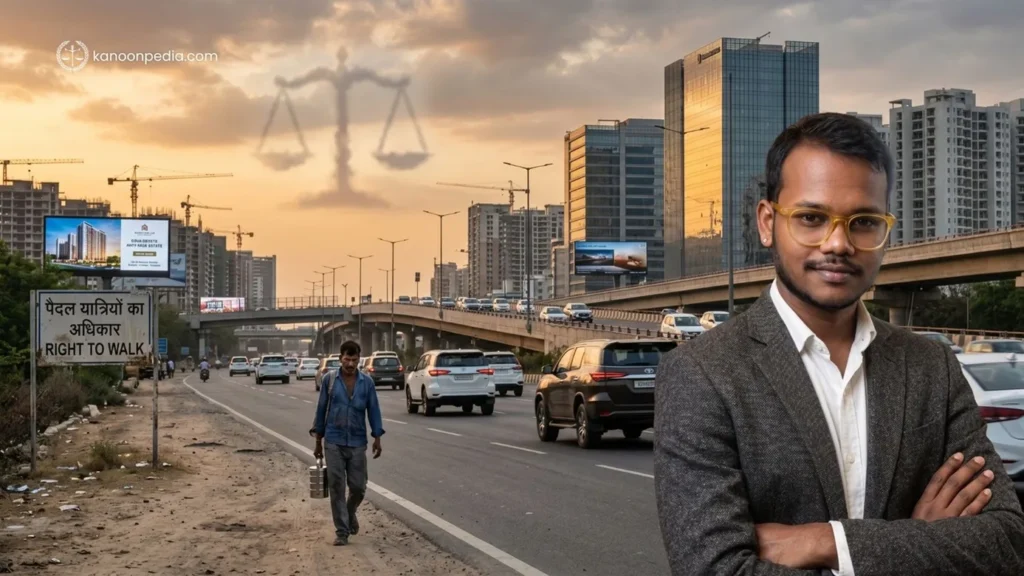
Table of Contents
Right to Walk on Footpath a critical discourse
In India walking on the road is considered as disadvantageous, poor and less adding to the economy. People having vehicles are considered rich and advantageous adding to the economy. So usually the capitalist mentality of governments doesn’t focus on people who are less productive in the capital. Justice PS Narsimha rightly points out this capitalist mentality in this recent case[2]–
“It is rather strange that we failed to focus on recognising and securing this “right to walk”. It may be because wheels eclipsed our imagination, and our municipal administration was busy creating roads that are suitable for motorised vehicles. It could also be elitism to start with, for machines with wheels were only for the rich, but as economies progressed and cheaper motor vehicles were introduced, the entire spectrum of motorised transportation dominated the roads, pushed aside the walkers to the extent that they are treated as a nuisance for the drivers who routinely run over the walkers and their footpaths………”
Again the similar argument is made by Carlos J.L. Balsas in his paper[3]. He argues that automobile dominated design of many cities as a kind of “tyranny” that has historically prioritised cars over people particularly harming those who are young, old, poor or otherwise unable to drive.
Henri Lefebrvre French Marxist philosopher and sociologist in his book[4] argues that urban space isn’t a neutral backdrop. It is actively produced through social and economic relations, and under capitalism, it gets shaped primarily to serve capital accumulations (Commerce, real estate, circulation of goods and labor) rather than people who live in it day to day. He distinguished between “abstract space” space organized around exchange value, efficiency, control – think highways, zoning ,real estate logic) and “lived space” (space as actually experienced and used by inhabitants streets , sidewalks, public squares). His argument is that capitalist urbanization systematically privileges the former over the latter.
A road built wide for cars, with no footpath, no shade, no place to simply stand or sit, that’s “abstract space” in leferbvre’s terms. It’s organized around throughput and circulation of vehicles and commerce, not around how a person on foot, especially a poor person, actually experiences and uses the street. So what gets built is highways, expressways and what gets neglected is footpaths. A number of deaths occur due to non availability of footpaths. People are compelled to walk on roads with the risk of losing their lives. But states keep neglecting these concerns.
The Indian supreme court is not the first supreme court to recognize the right to walk. Michigan Supreme court in Glass v Goeckel case[5] decided that members of the public can walk along the shore of a Great Lake (Lake Huron) without trespassing, even where private “littoral” (lakefront) owners hold titles down to the water’s edge.
Also this is not the first time when the supreme court has recognized the Right to walk on footpath as a fundamental right. Before this judgment the supreme court had several guidelines regarding pedestrian safety. In S Rajaseekarna v UOI[6] has issued directions for unobstructed and disabled friendly use of footpaths. Another bench compromising Justice JB Pardiwal has been monitoring the implementation of these directions and has also issued further directions relating to the safety of pedestrians on roads and footpaths, including the wearing of helmets, wrong lane driving and the use of unauthorised hooters on cars in a long standing writ petition.
The Supreme Court has asked the registry to register the case title – Re- Fundamental Right to Walk and Footpaths for further monitoring. It’s a welcoming decision but my concern is still the same. Until we change the capitalist mentality of government nothing is going to be substantially changed. Footpaths are basic for any civilised city. It shows that all residents are treated equally without economic capability. Now the big challenge before the SC is implantation of declared fundamental right to walk on footpaths.
About Author
Prof Ajay Chakrawarti is a dedicated legal scholar and academic currently serving as an Assistant Professor of Law at Abhiyoday University in Khadgaon, India . He holds a Master of Laws (LL.M.) from the prestigious National Law School of India University (NLSIU), Bengaluru. With a profound commitment to legal education and academic rigor, Professor Chakrawarti brings a highly analytical approach to his teaching and research. His scholarly foundation at India’s premier law university deeply informs his work, where he focuses on mentoring the next generation of legal professionals while contributing thoughtfully to contemporary legal discourse.
Citations
[1] Ministry of Road Transport & Highways, Government of India. “Highways Transformation: Powering India’s Journey 77 Towards Viksit Bharat.” Press Information Bureau, 14 June 2026, Release ID: 2272639. https://www.pib.gov.in/PressReleasePage.aspx?PRID=2272639®=3&lang=1
[2] Maniyar Iliyaz @Shaik Riyaz & Anr. V P. Ayyapan & ors 2026 INSC 647 (Para 5)
[3] Balsas, C.J.L. (2017). The right to walk in cities, comparative review of Macau, Lisbon and Las Vegas. International Journal of Law in the Built Environment, 9(2) 123-142.
[4] Lefebrvre, Henri. Le Droit a la Ville. (The Right to the City) Anthropos, 1968
[5] Glass v. Goeckedl, 703 N.W. 2d 1 (Mich. 2005).
[6] S. Rajaseekaran v UOI and Ors. AND ors.W.P. © No. 295/2012.