
Before diving down into Aids to Interpretation, Lets Imagine a judge staring at a single ambiguous section, with two lawyers offering two completely different readings of it. Where does the judge look for help? The answer is: everywhere a genuine clue can be found, both inside the four corners of the statute itself, and outside it. This Unit studies those tools, traditionally called ‘aids to interpretation’, and divides them into two neat families: internal aids (found within the statute book itself) and external aids (found outside it). Whichever approach a judge personally favours (literal, golden, purposive), she still reaches for these very same aids to build her reasoning.

| 💡 Why This Unit Matters Aids to Interpretation are not decorative; they are the judge’s toolbox. A well-drafted long title or preamble can settle a case in two lines, while a stray comma has genuinely decided the outcome of criminal appeals. Understanding these aids also means you will read every bare Act differently from now on: you will notice the marginal note, the proviso, the schedule, and ask what work each one is doing. |
Table of Contents
As a rule of thumb, courts turn to internal aids first, since they are part of the same document enacted by the legislature and therefore carry the most direct authority. External aids are used mainly to remove a doubt or ambiguity that internal aids alone cannot resolve; and, importantly, both kinds of aid are used only when the plain, unambiguous meaning of the statute is not already clear. If the language is clear, there is nothing to ‘aid’: the words are simply applied as they stand.
PART A: Internal Aids to Interpretation
Internal (or ‘intrinsic’) aids are materials found within the statute itself: its title, preamble, headings, marginal notes, sections, provisos, explanations, schedules, and even its punctuation. Because these elements are enacted (or at least officially attached) along with the statute, courts treat them as the first and most reliable source of guidance.
(a) Title: Short Title and Long Title
Every Act carries two kinds of title. The short title (for example, ‘the Indian Evidence Act, 1872’) is merely a convenient label or nickname used for quick reference; it does not describe the Act’s content and is not treated as an aid to interpretation.

The long title, set out at the very head of the Act, gives a fuller description of the general purpose and scope of the legislation (for example, ‘An Act to consolidate, amend and codify the law of evidence’). Courts have come to treat the long title as a legitimate aid: where a provision is genuinely ambiguous, the long title can help identify the general scope and object of the Act, though it can never be used to cut down or override language that is otherwise clear and unambiguous.

| ⚖️ Landmark Cases on Title Poppatlal Shah v. State of Madras, AIR 1953 SC 274: The Madras General Sales Tax Act, 1939 was described in its long title as an Act to levy tax on sales within the Province of Madras. The Supreme Court used the long title to hold that a sale completed outside Madras could not be taxed under this Act, even though the goods had at some point entered the city. Manoharlal v. State of Punjab, AIR 1961 SC 418: The Court held that while the long title indicates the general purpose of an enactment, it cannot override or control the clear, express words of a specific section such as Section 7(1) of the Act in question. Aswini Kumar Ghosh v. Arabinda Bose, AIR 1952 SC 369: The Supreme Court relied on the long title of the Supreme Court Advocates (Practice in High Courts) Act, 1951 to hold that a Supreme Court advocate had the right to both act and plead in any High Court without instructions from an attorney. |
(b) Preamble
The preamble is a short, prefatory statement, usually placed just below the long title, explaining the reason, motive, and object behind the enactment. It is often described as the ‘key’ that opens the mind of the legislature (a phrase traced to Chief Justice Dyer and, in a slightly different form, Lord Coke). Like the long title, the preamble may be used to remove genuine ambiguity or to identify the mischief the statute was designed to address, but it cannot restrict or expand the enacting provisions when their language is already plain and free from doubt. The most vivid Indian example of a preamble at work is the Preamble to the Constitution of India itself, whose words (Sovereign, Socialist, Secular, Democratic Republic; Justice, Liberty, Equality, Fraternity) have repeatedly guided constitutional interpretation.
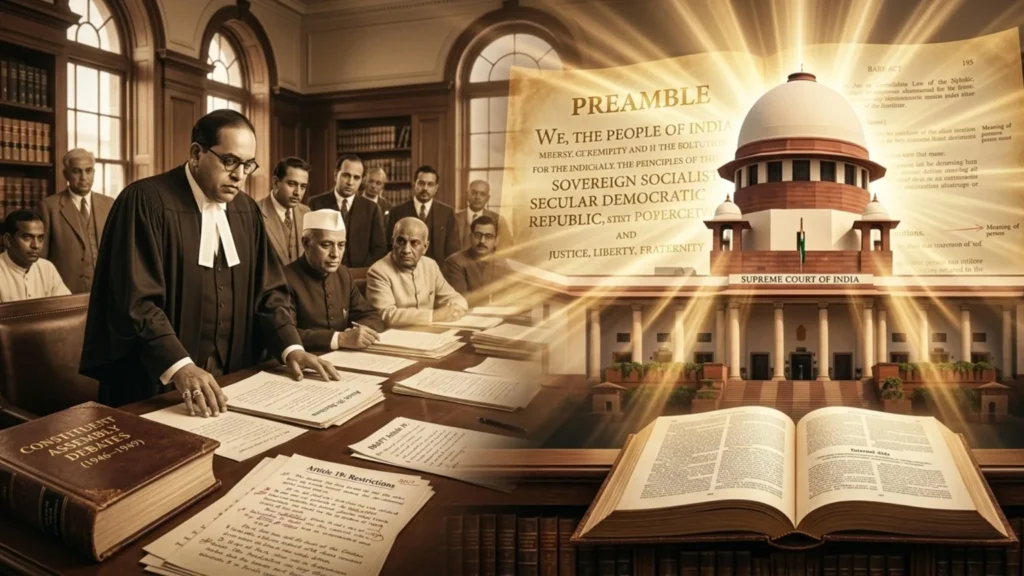
| ⚖️ Landmark Cases on Preamble Attorney General v. Prince Ernest Augustus of Hanover, (1957) AC 436: Lord Normand held that the preamble is a permissible aid to construing the enacting words, particularly where those words are doubtful, but it cannot control clear and unambiguous enacting language, and it carries less weight than another operative provision found elsewhere in the same Act. Kesavananda Bharati v. State of Kerala, AIR 1973 SC 1461, and Minerva Mills Ltd. v. Union of India, AIR 1980 SC 1789: The majority in both cases relied heavily on the Preamble to the Constitution to hold that the amending power under Article 368 is not unlimited, and cannot be used to destroy the ‘basic structure’ of the Constitution. Burrakur Coal Co. v. Union of India, AIR 1961 SC 954: The Supreme Court held that where the enacting provision itself is clear and unambiguous, the word ‘unworked land’ appearing in the preamble cannot be used to cut down or distort that plain meaning. |
(c) Headings and Marginal Notes
Headings introduce a group of sections dealing with a common theme (for example, ‘Offences Against the State’), while marginal notes (also called side notes) are the short notes printed alongside a section summarising its content. The traditional and still dominant view, both in England and in India, is that marginal notes are inserted by the drafter for convenience of reference, not debated or voted upon by the legislature, and are therefore not a reliable aid to construction; they cannot be used to control the meaning of the section itself. However, Indian courts have carved out an important exception for the Constitution of India, whose marginal notes were themselves framed and adopted by the Constituent Assembly, and may therefore be looked at for guidance, especially to remove an ambiguity.
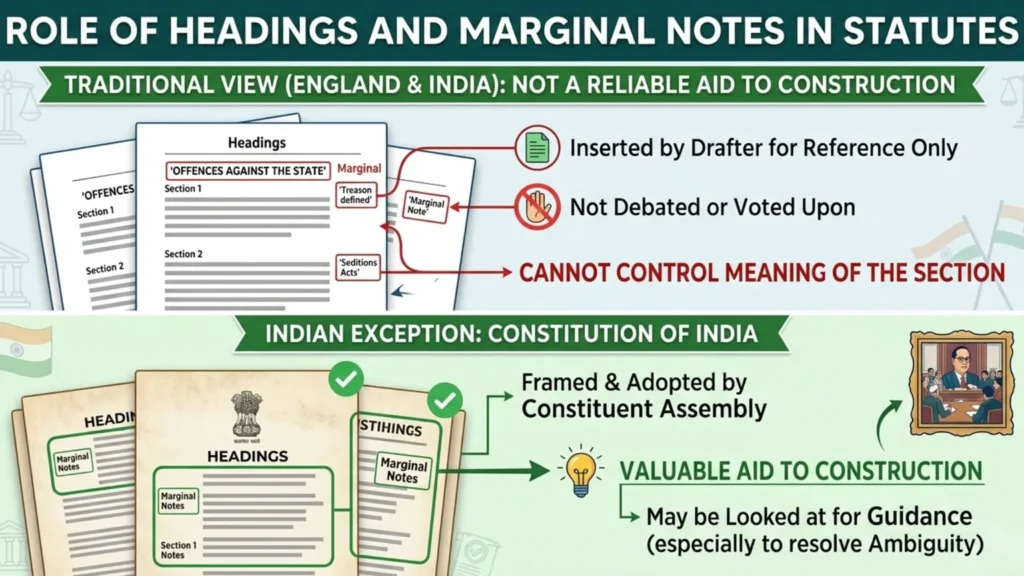
| ⚖️ Landmark Cases on Marginal Notes Bengal Immunity Co. Ltd. v. State of Bihar, AIR 1955 SC 661: Since the marginal notes to Articles of the Constitution were themselves passed by the Constituent Assembly, they were held to form part of the Constitution and could be used to throw light on the meaning and purpose of a provision, such as Article 286. K.P. Varghese v. Income Tax Officer, AIR 1981 SC 1922: The Supreme Court clarified that although a marginal note cannot be used to control the interpretation of clear words in a section, it can still be relied upon to indicate the general drift or subject matter of that section, and often furnishes a useful prima facie clue to its purpose. |
(d) Sections, Sub-sections and Definition (Interpretation) Clauses
A statute must always be read as an organic whole; the meaning of one section can often be clarified by comparing it with other sections of the same Act. Most modern statutes also contain a dedicated ‘definitions’ or ‘interpretation’ section (commonly Section 2 or Section 3), which fixes the meaning of important recurring terms used throughout the Act. These statutory definitions are extremely powerful: unless the Act says a defined term is to be understood ‘unless the context otherwise requires’, courts must apply the given definition even if it departs from the ordinary dictionary meaning of the word.
(e) Punctuation Marks

Historically, punctuation was treated as no part of a statute at all, since older Acts were often enrolled and read without any punctuation, and courts preferred to read a section as if it had no punctuation and rely purely on the sense of the words. Modern statutes, however, are punctuated at the drafting stage, so punctuation is no longer entirely ignored; it may be looked at as a minor, subordinate aid where the sense of a sentence is genuinely doubtful, but a court will never allow a comma or full stop to override the evident intention of the legislature gathered from the words themselves.

| ⚖️ Landmark Case on Punctuation Mohd. Shabbir v. State of Maharashtra, AIR 1979 SC 564: While interpreting Section 27 of the Drugs and Cosmetics Act, 1940, the Supreme Court examined the placement of commas in the provision to determine whether it created one offence or several distinct offences, illustrating that punctuation can occasionally matter but only as a supporting factor, never as the sole basis for meaning. |
(f) Illustrations
Several Indian codes, most famously the Indian Penal Code and the Indian Evidence Act, append illustrations (simple hypothetical examples) below many sections to show how the section is meant to apply. Illustrations form part of the statute and are a valuable, practical aid to understanding a difficult section. However, they are subordinate to the section: an illustration cannot be used to expand, restrict, or override the plain language of the section it accompanies. Where a genuine conflict appears between the section and its illustration, the section always prevails.
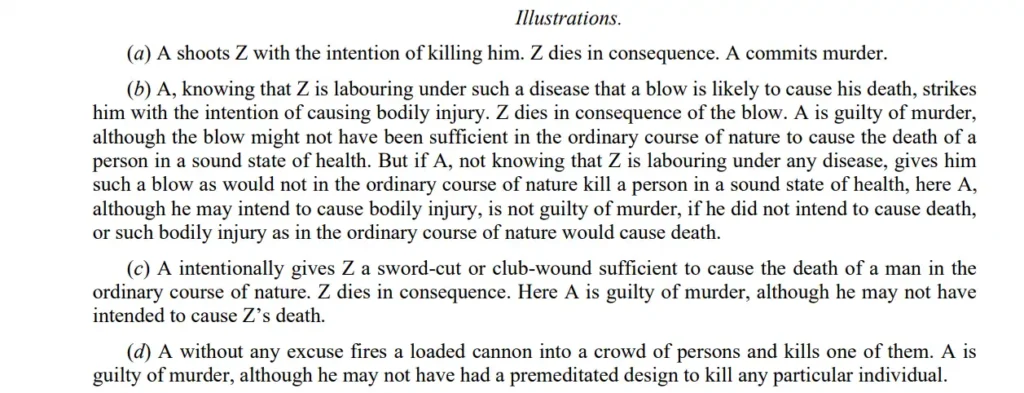
| ⚖️ Landmark Case on Illustrations Mahomed Syedol Ariffin v. Yeoh Ooi Gark, (1916) LR 43 IA 256 (Privy Council): The Privy Council held that illustrations appended to a section are of relevant weight in interpreting the text of the section, and should not be lightly treated as of no value; a court should not construe a section in a manner that conflicts with an illustration unless it is absolutely compelled to do so. |
(g) Exceptions, Provisos and Saving Clauses
An exception is generally used to exempt something from the main provision, taking it entirely outside the scope of the section. A proviso, usually introduced by the words ‘provided that’, qualifies, carves out, or creates an exception to the main (enacting) part of a section; the natural presumption is that, but for the proviso, the enacting part would otherwise have covered the subject matter dealt with in the proviso. As a general rule, a proviso is meant only to remove special cases from the general provision and to provide for them separately; it should not ordinarily be interpreted to enlarge the scope of the main section, and it takes its colour and content from the very provision to which it is attached. A saving clause, on the other hand, is typically found in a repealing or amending Act and is used to preserve (save) rights, privileges, or proceedings that would otherwise be lost because of the repeal or amendment (this connects directly back to Section 6 of the General Clauses Act ).

| ⚖️ Landmark Case on Proviso and Explanation S. Sundaram Pillai v. V.R. Pattabiraman, AIR 1985 SC 582: This is the leading Indian authority distinguishing a proviso, an explanation, and a non-obstante clause. The Supreme Court held that the normal function of a proviso is to except something out of the enacting provision or to qualify it, but a proviso may occasionally be so worded as to itself become a substantive provision. An explanation, by contrast, is meant only to clarify or make plain the meaning of the main provision, to fill in a gap, or to include something that would otherwise be excluded, but not to widen the ambit of the section beyond what was originally intended. |
(h) Explanation
An ‘Explanation’ is often appended to a section to clarify an ambiguity, remove a doubt, or make explicit something that was implicit in the main provision. Like the proviso, an explanation must be read together with, and takes its meaning from, the section to which it is attached; it is not meant to expand the substantive scope of the section (see S. Sundaram Pillai v. V.R. Pattabiraman, above).
(i) Schedules
Schedules are appended towards the end of an Act to avoid overloading the main body of sections with excessive detail (for example, long lists of forms, fees, rates of duty, or repealed enactments). A schedule forms part of the statute and must be read together with the sections that refer to it. If there is a genuine and irreconcilable conflict between the body of an Act and its schedule, the body of the Act, being the principal enacting part, will normally prevail, since a schedule cannot be used to control or override a clear provision found in the main enactment.
(j) Non-obstante Clause
A non-obstante clause is a provision beginning with words such as ‘notwithstanding anything contained in…’. Its purpose is to give the provision in which it appears an overriding effect over anything to the contrary found elsewhere in the same Act, or in some other specified law. In other words, when there is a clash between the non-obstante provision and another provision, the non-obstante provision prevails to the extent of that inconsistency. Courts, however, read the scope of a non-obstante clause strictly, limited to what is genuinely necessary to remove the identified conflict, rather than treating it as a general licence to ignore the rest of the Act.
| ⚖️ Landmark Case on Non-obstante Clause R.S. Raghunath v. State of Karnataka, AIR 1992 SC 81: The Supreme Court explained that a non-obstante clause is usually appended to a provision to indicate that the provision so qualified shall prevail despite anything to the contrary in the provisions mentioned in the non-obstante clause; but the scope of such a clause has to be limited to the actual area of conflict and it cannot be interpreted to displace other harmonious provisions of the same statute that are not genuinely inconsistent with it. |
Quick summary table of internal aids, with the golden rule for each:
| Internal Aid | Golden Rule of Use |
| Short Title | Never used for interpretation; a mere label. |
| Long Title | May resolve genuine ambiguity; cannot override clear words. |
| Preamble | Key to the legislature’s mind; cannot override clear enacting words. |
| Heading / Marginal Note | Generally not authoritative (except the Constitution); at best a minor clue to the section’s drift. |
| Definitions / Interpretation Clause | Binding, unless the Act itself says ‘unless the context otherwise requires’. |
| Punctuation | A minor, last-resort aid; never decisive on its own. |
| Illustration | Explains the section but cannot override or expand it. |
| Proviso | Qualifies or excepts from the main provision; takes colour from it. |
| Explanation | Clarifies, does not enlarge, the main provision. |
| Schedule | Part of the Act, but yields to the body of the Act in case of real conflict. |
| Non-obstante Clause | Gives overriding effect, but only to the extent of the actual conflict identified. |
PART B: External Aids to Interpretation
External (or ‘extrinsic’) aids are materials that lie outside the four corners of the statute: dictionaries, other statutes, translations, legislative debates, official reports, prior administrative practice, and general interpretation statutes like the General Clauses Act. Indian courts, unlike the older, more restrictive English tradition, have become progressively more willing to consult such external material, though always as an aid, never as a substitute for the statutory text itself.
(a) Dictionaries
Where a word used in a statute is not specifically defined in that statute, courts may refer to standard dictionaries to discover its ordinary, popular meaning. This aid must be used carefully: a dictionary offers several alternative meanings for most words, so a court still has to select the meaning that fits the particular statutory context, and dictionary meaning must always give way where the statute itself supplies a specific definition.
Few law Dictionary examples :
Webster’s New World Law Dictionary
The People’s Law Dictionary
| ⚖️ Landmark Case on Dictionary Meaning Grasim Industries Ltd. v. Collector of Customs, (2002) 4 SCC 297: The Supreme Court cautioned that dictionary meanings can, at best, be a guide, and cannot be blindly adopted when a word has to be understood in a particular statutory context; the setting and scheme of the enactment will often colour which of several possible dictionary meanings should be preferred. |
(b) Translations
In a multilingual country such as India, many statutes (and, historically, several princely-state laws and regional enactments) exist in more than one language, or an English text may be a translation of an original vernacular enactment (or vice versa, as with Hindi translations prepared under the Official Languages Act, 1963). Where an authoritative translation exists, courts may compare both texts to resolve a genuine ambiguity, since a mismatch between two authoritative versions of the same law can itself be a strong clue that the provision needs closer reading. Where one text is a mere unofficial translation, however, the original enacted text remains controlling.

(c) Travaux Preparatoires (Parliamentary History)
This French phrase (literally, ‘preparatory works’) refers to the entire legislative history behind an Act: the bill as originally introduced, amendments moved during its passage, the Statement of Objects and Reasons, reports of parliamentary debates, and resolutions of either House. The traditional English rule of exclusion held that such material could not be looked at to interpret a statute; Indian courts began by broadly following this rule but have progressively relaxed it, particularly for constitutional interpretation, treating parliamentary history as useful background material to understand the context, background, and object of a provision, while making clear that such material is never treated as conclusive or binding on the court’s final interpretation.

| ⚖️ Landmark Cases on Parliamentary History Indira Sawhney v. Union of India, AIR 1993 SC 477 (the Mandal case): While interpreting the phrase ‘backward class of citizens’ in Article 16(4) of the Constitution, the Supreme Court referred to Dr. B.R. Ambedkar’s speech in the Constituent Assembly, holding that reference to Constituent Assembly debates is permissible to ascertain the context, background and object of a provision, though such references are not conclusive. State of West Bengal v. Subodh Gopal Bose, AIR 1954 SC 92: Unlike the more restrictive view taken earlier in Ashwini Kumar Ghosh’s case regarding the use of the Statement of Objects and Reasons, Justice S.R. Das here used the Statement of Objects and Reasons to understand the social, economic and political conditions (namely, the position of sharecroppers under the zamindari system) that prompted the legislation. Harsharan Verma v. Tribhuvan Narain Singh, AIR 1971 SC 1331: While interpreting Article 164(4) of the Constitution, the Supreme Court referred to an amendment that had been proposed but rejected by the Constituent Assembly, to show that the framers did not intend to require a Minister to already be a member of the Legislature at the time of appointment. |
(d) Statutes in Pari Materia
The Latin phrase ‘pari materia’ means ‘upon the same matter or subject’. Where a statute is silent, unclear, or uses an undefined term, courts may look at other statutes dealing with the same subject matter (or forming part of the same legislative scheme) to understand how that term or concept has been used elsewhere. This is simply an extension of the ordinary rule that a document should be read in its proper context; it does not require the two statutes to be identical in scope, only that they relate to the same class of persons, things, or subject.

| ⚖️ Landmark Cases on Pari Materia State of Madras v. A. Vaidyanatha Iyer, AIR 1958 SC 61: The Supreme Court held that Section 4 of the Prevention of Corruption Act, 1947 (which raises a presumption once acceptance of gratification is proved) is in pari materia with the Indian Evidence Act, 1872, and the meaning of the phrase ‘shall presume’ as understood under the Evidence Act was used to construe the identical phrase used in the Corruption Act. State of Punjab v. Okara Grain Buyers Syndicate Ltd., AIR 1964 SC 669: The Court clarified that two statutes need not have an identical scope to be treated as in pari materia; it is enough that some provision in one may reasonably be regarded as dealing with the same subject matter as a provision in the other. |
(e) Contemporanea Exposition
This Latin maxim, in full ‘contemporanea expositio est optima et fortissima in lege’ (contemporaneous exposition is the best and strongest in law), means that the meaning given to a statute by those who worked closely with it at, or soon after, the time it was passed is strong evidence of its true meaning. In practice, this aid is most often used to justify relying on long-standing administrative practice, departmental circulars, or executive interpretation of a statute (particularly older or ancient statutes) as a guide to how the provision was originally intended to operate, though such administrative interpretation can never override the plain words of the statute if a court eventually finds them to be genuinely clear.

| ⚖️ Landmark Case on Contemporanea Exposition Desh Bandhu Gupta v. Delhi Stock Exchange Association Ltd., AIR 1979 SC 1049: The Supreme Court held that contemporaneous construction placed by administrative or executive officers charged with executing a statute, though not binding on the court, is a valuable aid and is entitled to great weight, particularly where that interpretation has stood unchallenged over a long period of time. |
(f) Debates, Inquiry Commission Reports, and Law Commission Reports

Closely connected to travaux preparatoires, courts may consult the reports of Commissions of Inquiry, Law Commission of India reports, or Select Committee reports that preceded a piece of legislation, in order to identify the ‘mischief’ or defect in the earlier law that the new statute was designed to cure (this connects to the mischief rule). Such reports are especially useful for tracing legislative history and for understanding why a particular reform was introduced, even though the final statutory text, not the report, remains the binding law.
(g) The General Clauses Act, 1897, as an External Aid

As we are aware, the General Clauses Act, 1897 supplies standard, ready-made definitions (for words such as ‘person’, ‘immovable property’, ‘affidavit’, ‘financial year’) and standard interpretation rules (on commencement, repeal, gender, number, and the computation of time) that automatically apply to every Central Act and Regulation, unless that particular Act expresses a contrary intention. Because it operates across the whole body of central legislation rather than being part of any single statute, it is properly classified as an external aid, even though its practical effect (supplying missing definitions) closely resembles the internal ‘definitions clause’ discussed earlier in this Unit.
| 🎓 Interesting Fact : India’s Constituent Assembly debates, running from December 1946 to November 1949, span over one thousand hours of recorded discussion. For decades, Indian courts largely refused to look at these debates while interpreting the Constitution, following the old English exclusionary rule. It was really from cases like the Kesavananda Bharati case and, decisively, Indira Sawhney’s case that the Supreme Court began openly quoting Dr. Ambedkar and other framers by name in its judgments, a striking example of how travaux preparatoires slowly earned its place as a respected external aid in India. |
Quick Recap: Internal Aids vs External Aids
| Feature | Internal Aids | External Aids |
| Location | Found within the statute itself | Found outside the statute |
| Examples | Title, preamble, headings, marginal notes, sections, provisos, explanations, schedules, non-obstante clauses, punctuation, illustrations | Dictionaries, translations, parliamentary history, statutes in pari materia, contemporanea exposition, debates, Commission and Law Commission reports, General Clauses Act |
| Authority | Generally stronger, since it is enacted (or officially attached) by the legislature itself | Persuasive and supportive, never conclusive or binding on the court |
| When Used | Used first, to resolve ambiguity from within the four corners of the Act | Used mainly when internal aids leave the ambiguity unresolved |
| 📝 Self-Test Questions for Revision 1. Distinguish between the short title and long title of a statute. Can the long title ever override an unambiguous section? Discuss with case law. 2. ‘Marginal notes are generally not a safe guide to interpretation, except in the Constitution of India.’ Explain with reference to Bengal Immunity Co. v. State of Bihar and K.P. Varghese v. Income Tax Officer. 3. Distinguish between a proviso, an explanation, and a non-obstante clause, referring to S. Sundaram Pillai v. V.R. Pattabiraman. 4. What is meant by ‘statutes in pari materia’? Illustrate with a decided case. 5. Explain the maxim contemporanea expositio est optima et fortissima in lege with the help of a leading case. 6. To what extent can Indian courts refer to parliamentary debates and the Statement of Objects and Reasons while interpreting a statute? |
Frequently Asked Questions (FAQs)
1. What are aids to interpretation in law?
Aids to interpretation are statutory tools, materials, and context that judges use to determine the true meaning and legislative intent of ambiguous legal provisions. They are divided into internal aids (found within the statute) and external aids (found outside the statute).
2. What is the difference between internal and external aids to interpretation?
Internal aids are elements located within the four corners of the Act itself, such as the preamble, title, provisos, and schedules. External aids lie outside the Act, such as legal dictionaries, parliamentary debates, commission reports, and other statutes in pari materia.
3. When can courts use aids to interpretation?
Courts use aids to interpretation only when the language of a statute is ambiguous, vague, or doubtful. If the plain language of a provision is clear and unambiguous, no aids are necessary, and the literal rule of interpretation applies.
4. What is the difference between a short title and a long title of a statute?
A short title is merely a label or nickname for quick reference (e.g., The Indian Evidence Act, 1872) and carries no interpretive value. A long title outlines the general scope and object of the legislation and can be used to resolve genuine statutory ambiguities.
5. Can a preamble override the clear words of an enacting section?
No. While a preamble serves as the “key to open the mind of the legislature” and clarifies general intent, it cannot restrict, extend, or override explicit provisions when their language is plain and free from doubt (Burrakur Coal Co. v. Union of India).
6. Are marginal notes considered reliable internal aids to interpretation?
Generally, no. Marginal notes are inserted by drafters for quick reference and are not voted on by the legislature. However, an exception exists for the Constitution of India, where marginal notes were debated and adopted by the Constituent Assembly (Bengal Immunity Co. v. State of Bihar).
7. What is the legal difference between a proviso and an explanation?
As established in S. Sundaram Pillai v. V.R. Pattabiraman, a proviso qualifies or carves out an exception to the main enacting section. An explanation clarifies ambiguities, removes doubts, or makes explicit what was implicit, without widening the section’s substantive scope.
8. How do illustrations in Indian statutes assist in interpretation?
Illustrations are practical hypothetical examples appended below sections (common in the Indian Penal Code and Evidence Act). They form part of the statute and carry persuasive weight (Mahomed Syedol Ariffin v. Yeoh Ooi Gark), but they cannot override or expand the plain language of the main section.
9. What is a non-obstante clause and what is its effect?
A non-obstante clause usually begins with “notwithstanding anything contained in…” and gives the section overriding authority in case of a conflict with other provisions or laws. Courts limit its scope strictly to the area of actual conflict (R.S. Raghunath v. State of Karnataka).
10. What happens if there is a conflict between the body of an Act and its Schedule?
Schedules are appended to statutes to house detailed lists, forms, or technical data. If an irreconcilable conflict arises between the principal body of the Act and its Schedule, the main enacting sections of the Act prevail.
11. What does “statutes in pari materia” mean?
In pari materia refers to statutes dealing with the same subject matter or person. When a provision in one Act is unclear, courts look at how the same terms or concepts are interpreted in other statutes of the same legislative framework (State of Madras v. A. Vaidyanatha Iyer).
12. What are travaux préparatoires in statutory interpretation?
Travaux préparatoires (preparatory works) refers to the legislative history of an Act, including original bills, amendments, statements of objects and reasons, and parliamentary debates. Courts consult them as background context to understand the mischief an Act intended to cure.
13. Can Constituent Assembly debates be used to interpret the Constitution of India?
Yes. Although Indian courts historically followed a strict exclusionary rule, landmark judgments like Kesavananda Bharati and Indira Sawhney established that Constituent Assembly debates (such as speeches by Dr. B.R. Ambedkar) are permissible external aids to understand context and intent.
14. What is the doctrine of contemporanea expositio?
Contemporanea expositio (contemporanea expositio est optima et fortissima in lege) means that the construction given to an ancient statute by those who lived when it was enacted or executed is entitled to great weight, such as long-standing executive circulars (Desh Bandhu Gupta case).
15. Why is the General Clauses Act, 1897 classified as an external aid?
The General Clauses Act, 1897 provides standard rules of construction and uniform statutory definitions (like “person” or “immovable property”) across all Central Acts. Because it exists outside any individual statute, it acts as a universally applicable external aid.
About the Author
This is a product of research by a group of advocates practicing in various High courts and Supreme court of India. The whole group has been consistently publishing on various topics and fields of laws for making the citizens aware of their right. Keep reading Kanoonpedia.com
More to read Rules of Statutory Interpretation