
1. Introduction
Imagine walking into a job interview only to be asked if you’re from a “reserved” category—and then being lectured on how “unsuitable” you are for a senior role because you’re a woman. That double reality—a social hierarchy based on caste and gender bias—shapes the lives of many in India.
Intersectional discrimination is not just the sum of caste bias plus gender bias; it creates a unique lived experience that demands an equally nuanced legal response. Article 15 of the Indian Constitution stands as a fortress against discrimination on grounds like religion, race, caste, sex, and place of birth, but its application to intersectional claims is still evolving.
In this comprehensive guide, you’ll learn:
- What intersectional discrimination means under Indian law.
- How Article 15 can be leveraged to address overlapping caste and gender claims.
- Practical steps, case studies, and comparative insights to craft strong intersectional petitions.
Whether you’re a lawyer, activist, or curious reader, this post arms you with knowledge, examples, and tools to champion inclusive justice.
Table of Contents
2. Bare Provision: Article 15 of the Constitution
Article 15 (Extract):
- The State shall not discriminate against any citizen on grounds only of religion, race, caste, sex, place of birth or any of them.
- No citizen shall, on grounds only of religion, race, caste, sex, place of birth or any of them, be subjected to any restriction with respect to access to shops, public restaurants, hotels and places of public entertainment, or the use of wells, tanks, bathing ghats, roads and places of public resort maintained wholly or partly out of State funds or dedicated to public use.
- Nothing in this article shall prevent the State from making any special provision for women and children.
- Nothing in this article shall prevent the State from making any special provision for the advancement of any socially and educationally backward classes of citizens or for the Scheduled Castes and the Scheduled Tribes.
- Nothing in this article shall prevent the State from making any special provision, by law, for the advancement of any socially and educationally backward classes of citizens or for the Scheduled Castes and the Scheduled Tribes in so far as such special provisions relate to admissions to educational institutions including private educational institutions, whether aided or unaided by the State.
Key Insight: Article 15 prohibits discrimination but also empowers affirmative action. The challenge is applying it where discrimination is neither purely caste-based nor purely gender-based but a fused reality.
3. What Is Intersectional Discrimination?
Intersectional discrimination occurs when multiple social identities—such as caste and gender—interact in ways that compound disadvantages. Key features:
Compound Harm: The discrimination faced is qualitatively different from separate caste or gender bias.
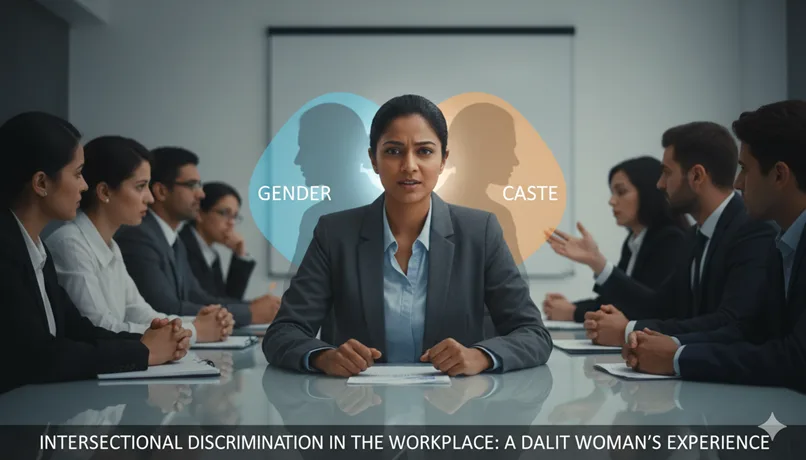
Unique Experience: A Dalit woman’s workplace Harassment includes stereotypes about caste-based “cleanliness” and gendered subservience.
Legal Blindspot: Traditional single-axis frameworks may fail to capture the combined harm.
Long-tail keywords integrated:
- intersectional discrimination in Indian law
- caste and gender intersection under Article 15
- intersectional claims in constitutional law
4. Understanding Article 15 in Context
4.1 Prohibited Grounds of Discrimination
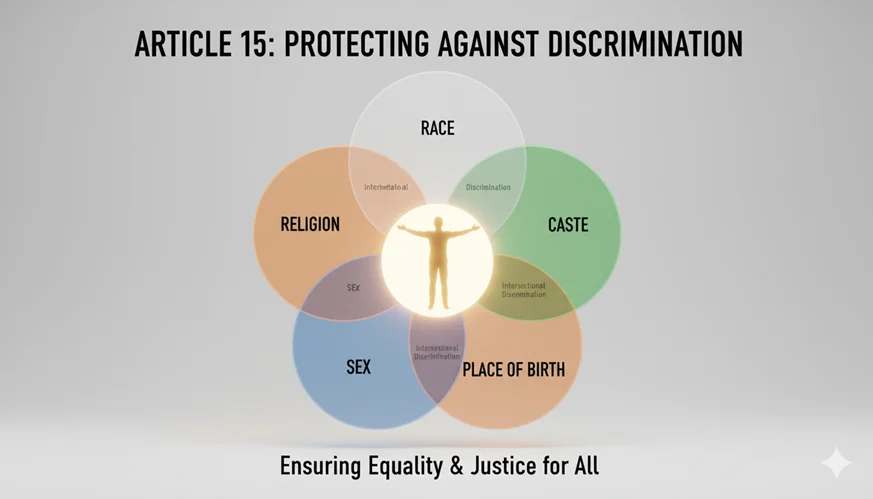
Article 15 bars discrimination on:
- Religion
- Race
- Caste
- Sex
- Place of birth
4.2 Direct vs Indirect Discrimination
- Direct Discrimination: Explicit unequal treatment (e.g., barring women from certain jobs).
- Indirect Discrimination: Seemingly neutral rules that disproportionately impact a marginalized group (e.g., height requirements affecting women).
Quick Takeaway: While Article 15 is clear on individual grounds, its text is silent on overlapping grounds, leading courts to interpret “grounds only of” narrowly.
5. The Idea of Intersectionality: Beyond Single-Axis Claims
Kimberlé Crenshaw coined “intersectionality” to critique legal frameworks that addressed only one form of marginalization at a time. In India:
- Historical focus has been on separate claims—for example, cases challenging caste bias or gender bias alone.
- Intersectional analysis demands courts ask: “Did the applicant suffer discrimination specifically because she is a Dalit woman?”
Reflective Question: Have you ever experienced or witnessed a form of discrimination that felt “more than the sum of its parts”?
6. Why Caste and Gender Often Intersect in India
India’s complex social hierarchies mean caste and gender biases reinforce each other:
- Social Exclusion: Dalit women are disproportionately denied access to public spaces like temples or water sources.
- Economic Exploitation: Forced into low-paying, demeaning jobs with no social security.
- Violence: National Crime Records Bureau data shows Dalit women face higher rates of sexual violence than upper-caste women.
Did you know? Studies show Dalit women are over four times more likely to face sexual violence than upper-caste women—highlighting the need for intersectional legal remedies.
7. Case Studies on Intersectional Discrimination Under Article 15
7.1 Air India v. Nergesh Meerza (1981)
- Issue: Gender-based service rules for air hostesses.
- Outcome: Court struck discriminatory provisions but did not address caste-gender overlap.
7.2 Anuj Garg v. Hotel Association of India (2008)
- Issue: Ban on women working in bars (gender).
- Outcome: Struck down as violation of equality; Court emphasized real equality beyond stereotypes—paving indirect way for intersectional reasoning.
7.3 Navtej Singh Johar v. Union of India (2018)
- Issue: Section 377 and LGBT rights under “sex” discrimination.
- Outcome: Expanded concept of “sex” under Article 15 to include sexual orientation—demonstrating scope for interpretive growth.
7.4 Dalit Women’s Workplace Harassment
- Context: Manual scavenging cases involving Dalit women illustrate layered discrimination—both caste stigma and gendered abuse.
- Lesson: Courts need explicit intersectional frameworks to deliver justice.
Quick Takeaway: Indian judiciary has shown seeds of interpretive expansion but lacks explicit recognition of intersectional claims.
8. The Challenges in Proving Intersectional Discrimination
- Jurisprudential Gap: Few judgments explicitly acknowledge overlap of grounds.
- Evidentiary Hurdles: Victims often lack resources to gather sociological evidence.
- Stigma & Silence: Social barriers prevent open discussion of caste-gender harms.
Expert Tip: Collaborate with sociologists and NGOs to collect affidavits, data, and expert reports demonstrating compound harms.
9. Common Myths About Article 15 Discrimination
Myth 1: Article 15’s affirmative action provisions automatically cover intersectional harms.
Reality: Affirmative action targets structural inequality but does not guarantee remedies for specific intersectional incidents.
Myth 2: Intersectionality is a Western concept with no place in Indian law.
Reality: Indian social realities make intersectional analysis even more critical—courts can adapt interpretive methods used for sexual orientation or disability.
10. Practical Strategies for Advancing Intersectional Claims
- Draft Combined-Ground Petitions: Explicitly plead discrimination “as a Dalit woman.”
- Invoke Expanded Interpretations: Leverage Navtej Johar’s reasoning on “sex.”
- Use International Law: Cite CEDAW and UN reports supporting intersectional remedies.
- Empirical Evidence: Partner with research bodies for data-driven affidavits.
- Public Interest Litigation: Engage civil society to highlight systemic patterns.
Know more about Public Interest Litigation
11. Comparative Insights: Global Jurisprudence on Intersectionality
- United States: Title VII cases recognize multiple-ground claims in employment discrimination.
- Canada: Charter interpretations and human rights codes explicitly allow intersectional claims.
- South Africa: Constitutional Court embraces intersectionality in equality jurisprudence.
Quick Takeaway: India can draw on global precedents to articulate a robust intersectional doctrine under Article 15.
12. Internal and External Linking Suggestions
Internal Links:
- Article 14: Equality before Law
- Article 17: Abolition of Untouchability
- Fundamental Rights & Gender Justice in India
External Sources:
- National Campaign on Dalit Human Rights Report (2018)
- UN Women Report on Intersectional Discrimination (2020)
- Supreme Court judgments at indiankanoon.org
13. FAQs (People Also Ask)
Q1: What is intersectional discrimination under Article 15?
Discrimination faced due to overlapping identities—like caste and gender—rather than a single ground.
Q2: Can a woman claim both caste and gender discrimination together under Article 15?
Yes, by framing petitions on combined grounds, though jurisprudence is evolving.
Q3: How do Indian courts view intersectionality in constitutional cases?
They rarely name it “intersectionality” but have expanded “sex” and “equality” to address multiple identities.
Q4: Why is intersectional discrimination important in India?
Because caste and gender hierarchies often reinforce each other, harming Dalit women and others at multiple levels.
Q5: Does Article 15 apply to private employers?
Primarily to State actions, but courts use equality principles to influence private sector practices.
14. Checklist for Understanding Intersectional Claims
- Read Article 15’s text thoroughly.
- Grasp the difference between direct and indirect discrimination.
- Recognize how caste and gender intersect in lived experiences.
- Analyze key judgments for interpretive expansions.
- Gather empirical and expert evidence.
- Explore comparative jurisprudence.
15. Summary of Key Takeaways
- Intersectional discrimination under Article 15 addresses unique harms from overlapping social identities.
- Courts have begun interpretive expansion (Navtej Johar) but need explicit frameworks for caste-gender claims.
- Practical strategies include combined-ground pleadings, international treaties, and empirical data.
- Global precedents offer blueprints for India’s judiciary to adopt robust intersectional doctrines.
16. Conclusion + Call to Action
Intersectional discrimination under Article 15 is not a theoretical concept—it reflects real injustices that millions of Dalit women, tribal women, and other marginalized groups face daily. Recognizing and remedying these compounded harms is essential to fulfilling the Constitution’s promise of equality.
If you found this guide helpful, share it with peers, comment your reflections below, and subscribe for more deep dives into constitutional law and social justice in India. Together, let’s advance true equality at every intersection.
17. Author Bio
Adv. Arunendra Singh is an award-winning legal scholar, content strategist, and innovator who bridges traditional legal practice with emerging technologies. Currently at the National Law School of India University (NLSIU), Bangalore, he was honored with the President of India’s Award for exceptional academic and leadership achievements.
As Founder of Kanoonpedia, Arunendra has built a premier legal-education platform offering in-depth constitutional analyses, landmark case studies, and exam-focused guides. He is also Co-Founder of Clicknify, the “Anti-Agency Agency” for legal-tech startups. Using his proprietary Legal Clarity™ framework—which fuses doctrinal research, SEO-driven content architecture, and interactive study tools—he has elevated user engagement by over 70% and doubled session durations across both platforms.
In his consulting practice, Arunendra applies expertise in digital marketing and UX clarity audits to help edtech ventures achieve measurable growth through data-driven design and strategic conversion roadmaps. Trusted by top-tier law faculties, student associations, and early-stage startups, his hands-on workshops and advisory services have boosted organic traffic by 150% and transformed passive readers into active learners.
Connect with Adv. Arunendra Singh for thought leadership in legal innovation and technology law:
LinkedIn: https://www.linkedin.com/in/arunendrasingh31/